Showing posts with label MCP. Show all posts

Sunday, October 26, 2025

CHILIMA REFORMS: Detailed Summary: Review of Malawi Public Service Systems Report

Introduction

On February 19, 2021, President Lazarus McCarthy Chakwera appointed a Special Taskforce, chaired by Vice President Saulos Klaus Chilima, to review Malawi's public service systems focusing on allowances, procurement, and employment contracts. The goal was to recommend reforms for greater efficiency, effectiveness, and integrity, supporting the Malawi 2063 vision. The Taskforce also reviewed conditions of service and the overall structure of the public service. 

  Overall Observations

The Taskforce identified endemic abuses across allowances, procurement, and employment contracts, concluding that most control measures against wastage and abuse had collapsed. Key weaknesses included: Legal/Policy: Outdated, inadequate, and inconsistent laws (e.g., Public Service Act 1994, Malawi Public Service Regulations 1991). Systems/Procedures: Non-adherence, weak enforcement of rules and sanctions, lack of rewards for compliance. Human Capacity: Poor selection/deployment, lack of knowledge, ignoring procedures (like audit queries), weak performance management. Structures: Uncoordinated oversight, lack of a national body for harmonizing conditions, slow/partial devolution. ICT: Underutilization of Integrated Financial Management Information System, reliance on manual processes (allowances, procurement). Ethics: Moral decay, poor discipline, lack of integrity across the service. Equity: Remuneration disparities violating the principle of equal pay for work of equal value.

  
Key Findings and Recommendations by Area 


1. Allowances Problem: Allowances constitute a large part of the budget (Malawi Kwacha 79 Billion in 2019/20). Despite a 'clean wage' policy (2004), numerous allowances have created inequalities. Abuse is rampant, especially with subsistence allowances (Malawi Kwacha 33.7 Billion spent vs Malawi Kwacha 27.4 Billion approved in 2019/20). Billions lost through fraudulent claims (false travel, unauthorized activities, overlapping claims, unsigned receipts). Audit queries are largely ignored (only 1.5% of 908 internal audit queries resolved 2017-2020). Sitting allowances for Members of Parliament/staff amount to double payment for core duties. Parastatal board sitting allowances incentivize unnecessary meetings. Health worker 'Risk Allowance' is a double payment given existing 'Top-Up Allowance'.


  Recommendations: 


Local Travel: Implement a mandatory full-board system (direct payment to hotels) progressively from July 2021, replacing cash Daily Subsistence Allowance. Department of Human Resource Management and Development to negotiate government rates. Enforce 30-day payment of hotel invoices. Abolish illegal meal allowances for in-station meetings. External Travel: Abolish ad-hoc rate increases. Standardize rates based on destination costs (United Nations model) and make them uniform regardless of grade. Enforce limits on delegation size/duration. Strictly prohibit 'top-up' allowances for fully-funded trips. Sitting Allowances: Eliminate for Members of Parliament and Parliamentary staff. Replace per-meeting sitting allowances for Parastatal Boards with annual honoraria (paid quarterly). Stop Transport & Travel allowances for Ex-Officio board members using government vehicles/fuel. Parliament to budget for its own oversight visits, not rely on parastatals. Risk Allowance: Eliminate entirely. Address genuine profession-specific needs through conditions of service reviews. Accountability: Mandate immediate action on all outstanding audit queries by Controlling Officers within 30 days, with sanctions enforced by the Secretary to the President and Cabinet. Empower the Secretary to the Treasury (through Public Finance Management Act amendment) to surcharge officers personally liable for financial losses. Revive independent Audit Committees. Make action on audits a key performance indicator for Controlling Officers and the Secretary to the President and Cabinet. Appoint a permanent Auditor General immediately. 


2. Employment Contracts


Problem: Conflicts exist between the Public Service Act (Presidential appointment powers for Grade E+) and specific Parastatal Acts regarding hiring authority. Malawi Public Service Regulations (1991) is outdated. Poor enforcement of existing laws prevails. Political appointees (Personal Assistants, non-career diplomats) are often absorbed into the permanent civil service ("back-door entry"), demoralizing staff and politicizing the service. Some appointees are arbitrarily given higher grades without following procedures. Unqualified candidates are sometimes recruited, and procedures are flouted (ultra vires appointments, skipping interviews). Political influence, cronyism, and corruption affect recruitment. The practice of "warehousing" (deploying staff without assigning functions but paying them) exists. Recommendations: Legal Framework: Review and harmonize the Public Service Act, Malawi Public Service Regulations, and Parastatal Acts. Appointments in parastatals must follow their specific Act unless explicitly stated otherwise. Develop clear guidelines for Grade E+ recruitment. Political Appointees: Must not transition into the permanent civil service. Their contract length should align with their principal's term of office. Develop clear guidelines for implementing gender quotas (40/60) and hiring 'rare skills'. Irregularities: Terminate all irregular contracts (unqualified, unprocedural hires, political absorptions, post-retirement hires without approval) by June 2021. End "warehousing" immediately; use proper disciplinary or redundancy procedures. Resolve cases of redeployed officers within 3 months. Diplomats: Develop clear Malawi Public Service Regulations guidelines on eligibility, recruitment, and selection, aligning placements with foreign policy goals. Oversight: Establish a National Remuneration Directorate (under the recommended Public Service Commission) to harmonize pay/benefits across the entire public service. Conduct Human Resource audits across the service and act on findings.

  3. Conditions of Service 

Problem: Huge salary disparities exist, with the civil service paid significantly less than parastatals, violating 'equal pay for equal value'. Lowest civil service grades earn far below the basic needs basket (Grade R 61.5% below). Excessive vehicle (3500cc Prado for Grade C+) and fuel (500L/month) entitlements create massive costs (Malawi Kwacha 36.6 Billion purchase cost, Malawi Kwacha 4.07 Billion/year fuel) and wastage. Parastatals abuse vehicle disposal policies. Parastatal executives receive generous private school fees benefits, unavailable in the civil service. Performance management systems are largely dysfunctional and not linked to rewards/sanctions. Discipline has eroded due to poor enforcement and outdated regulations. Staff welfare systems (e.g., loan schemes) have collapsed. 

Recommendations: 

Salaries: Rationalize and harmonize across the public service. Raise lowest civil service pay towards the basic needs basket (phased, potentially using non-taxable housing/transport allowances). Freeze salaries in highest-paying parastatals. Review salaries against cost of living quarterly (via Public Service Commission). Ensure salaries are within approved scales (investigate Electricity Generation Company case). Vehicles/Fuel: Downgrade vehicle entitlements (e.g., Grade C to 2500cc like RAV4). Introduce a vehicle ownership loan scheme for Grade D and potentially lower grades. Reduce the number of vehicles for Ministers/Deputies/Grades A&B. Extend vehicle disposal period or increase buy-out price. Standardize fuel allowances. School Fees: Abolish the benefit entirely for executives in all public institutions (except diplomats posted abroad during their tour and transition period). Let current contracts expire. Systems: Enforce Performance Management rigorously, linking it to rewards/sanctions. Make it a key deliverable for Controlling Officers. Revamp disciplinary processes with clear manuals and strengthened committees. Re-establish staff welfare loan schemes (emergency, vehicle). Develop comprehensive welfare policies (health, work-life balance). Medical Scheme: Progressively roll out contributory medical cover to ALL civil servants, starting immediately with Grade I. 

  4. Procurement

Problem: The manual, paper-based system lacks transparency, enabling widespread malfeasance (fraud, corruption, collusion). Flawed processes include poor planning (bid slicing, under-budgeting), specifications tailored to favour suppliers, manipulation of evaluation criteria, abuse of single-sourcing, political interference, and awarding contracts to known poor performers. The 'lowest evaluated bid' principle often results in poor quality or abandoned projects. Government pays massively inflated prices. Multiple, confusing approval points (statutory: Public Procurement and Disposal Authority, Anti-Corruption Bureau; administrative: Office of the President and Cabinet, Government Contracting Unit, Ministry of Justice) cause delays and undermine Public Procurement and Disposal Authority's authority. Public Procurement and Disposal Authority lacks capacity (high vacancy rate). Consulting engineers lack accountability and sometimes collude with contractors. Framework agreements (e.g., Pharmaceutical Manufacturers Association of Malawi Memorandum of Understanding) lead to exorbitant prices. Preferential procurement rules lack clarity. 

  Recommendations: 

Digitization: Expedite rollout of e-Procurement system nationwide, including e-marketplaces for price comparison. Awarding Criteria: Mandate inclusion of past performance. Replace 'lowest evaluated bid' with 'most economically advantageous bid' for complex procurements. Combat Malfeasance: Require disclosure of beneficial owners. Link Public Procurement and Disposal Authority/Registrar General/Malawi Revenue Authority systems. Develop and enforce use of market price indexes. Sanction collusion and overpricing. Terminate the Pharmaceutical Manufacturers Association of Malawi Memorandum of Understanding immediately; use open competition with standard preference margins. Capacity & Planning: Upgrade procurement roles/grades within Ministries, Departments and Agencies. Fill all Public Procurement and Disposal Authority vacancies urgently. Enforce procurement planning aligned with budgets and the Public Sector Investment Programme. Ensure projects only start with full funding identified. Streamline Approvals: Remove administrative vetting layers (Office of the President and Cabinet, Government Contracting Unit role limited to contract support). Clarify Anti-Corruption Bureau's vetting role to avoid conflict with investigations. Resource Government Contracting Unit adequately for contract management support only. Withdraw circulars mandating specific suppliers/brands (e.g., Prado). Accountability: Hold consulting engineers professionally liable for substandard work (joint debarment with contractors). Public Procurement and Disposal Authority/National Construction Industry Council to regulate them better. Enforce strict sanctions (debarment, surcharge, prosecution) against officials and suppliers for misconduct. Intensify Public Procurement and Disposal Authority monitoring and post-reviews. 

  5. Restructuring the Public Service 

Problem: Lack of clear constitutional/legal definitions ("Government", "Public Service"). Secretary to the President and Cabinet's role as Head of the entire Public Service conflicts with the Constitution (only mentions Secretary to Cabinet) and Separation of Powers. No constitutional limits on the number of ministries, constituencies, or senior judges, leading to potential bloat and instability. Duplication and fragmentation of functions exist. Devolution is slow and incomplete. Governance of State-Owned Enterprises is weak (Department of Statutory Corporations relevance questioned, Reserve Bank of Malawi operates with excessive independence, inconsistent board structures). Political interference blurs lines between Ministers' policy/oversight roles and Principal Secretaries' administrative/implementation roles. 

  Recommendations:

Constitutional/Legal Clarity: Amend Constitution to clearly define "Government" and "Public Service". Establish an independent, overarching Public Service Commission responsible for harmonizing grading, remuneration, conditions, appointments, and discipline across the entire public service. Define Secretary to the President and Cabinet constitutionally as Head of the Civil Service only. Structure & Size: Introduce constitutional limits on the number of ministries (max 21 recommended), constituencies (max 200), and senior judges. Standardize definitions of ministry/department/division structures. Conduct a comprehensive functional review to eliminate duplication and align structure with Malawi 2063. System of Government: Hold a national conference and referendum to decide on the optimal system (presidential, parliamentary, hybrid) to address issues like Ministers serving as Members of Parliament. Stop assigning sitting judges to executive roles. Devolution: Fast-track complete devolution of functions, funding, assets, and Human Resource management to local authorities, making them the primary service delivery points. Central government to focus on policy, standards, Monitoring and Evaluation, and resource mobilization. State-Owned Enterprise Governance: Review the relevance of Department of Statutory Corporations. Standardize board appointments (competitive selection, independent chairs). Improve Reserve Bank of Malawi accountability (remove Public Finance Management Act exemption, review governance structure). Ensure all State-Owned Enterprises adhere to public finance laws. Roles: Amend Constitution/Public Service Act to clearly delineate Minister's role (policy formulation, direction, oversight) from Principal Secretary's role (chief executive: advising minister, implementation, day-to-day management). 

  Conclusion

The report proposes radical, systemic changes necessary to address the deep-seated dysfunction observed across Malawi's public service, affecting areas from daily allowances and procurement practices to employment conditions and the very structure of government. The success of these reforms hinges critically on several interconnected factors: Strong Political Will: This requires unwavering commitment from the highest levels of all three branches of government – the Executive, Legislature, and Judiciary. Leadership must set the example, accepting potential reductions in benefits (such as the proposed downgrading of vehicle entitlements for senior officials) and consistently enforcing sanctions against misconduct, even when politically sensitive. The recommendation to introduce performance appraisals for the Secretary to the President and Cabinet and even public participation in Ministerial appraisals underscores this need for top-down accountability. Comprehensive Legal Reforms: The foundation of the current dysfunction lies partly in outdated and inconsistent legislation. Implementing the recommendations necessitates significant legal changes, including amending the Constitution (to clarify definitions, establish the Public Service Commission, set limits on government size), updating the Public Service Act and Malawi Public Service Regulations, amending the Public Finance Management Act (e.g., to empower the Treasury to surcharge officials for losses), and harmonizing various Parastatal Acts. Without these legal underpinnings, reforms lack authority and enforceability. Improved Economic Performance Funded by Reduced Wastage: The report highlights billions lost through abuses – for instance, the Malawi Kwacha 7.08 billion in 'illegal allowances' noted in National Audit Office reports between 2010-2019, the estimated Malawi Kwacha 5.89 billion annual cost of executive school fees, or the potential Malawi Kwacha 46-50 billion in vehicle purchase savings over five years. Successfully curbing this wastage is not just an ethical imperative but an economic one. These recovered funds are essential to finance critical reforms like raising civil service salaries towards the basic needs basket and improving the provision of public services, thereby creating a virtuous cycle where better conditions reduce incentives for corruption. Buy-in from Public Servants and the Citizenry: Lasting change requires acceptance and participation from those within the system and those it serves. Clear, consistent communication is needed to explain why these reforms are vital, linking the identified abuses directly to poor service delivery and economic stagnation. Engaging public service unions, civil society organizations, and the media in monitoring implementation can build trust. Furthermore, fostering a culture change, as recommended through initiatives on ethics training in schools and the public service and identifying national champions for values, is crucial for embedding integrity long-term. Ultimately, addressing the identified weaknesses requires a coordinated, persistent effort across all these fronts. It demands confronting entrenched interests, overhauling outdated systems, and committing to transparency and accountability, demonstrating that ethical governance and efficient public service are the cornerstones for achieving the Malawi 2063 vision.

Saturday, February 6, 2021

Chewas think they made it in life

 The Chewa Heritage Foundation is looking for Chewa CVs. NonChewas need not apply! They want to see which Chewas have skills, you know, there might be some vacancies that might need a Chewa candidate in the Tonse future.

Though they are frantically trying to walk away from the release, two journalists have authenticated the release. They can deny it all they want; it is only because of the furore.

Nyau -Gold Standard of  'Malawian Culture'

We love our Chewa brothers, the history of Malawi is in part the history of the Chewas, but someone needs to call them out on their never-ending tribal myopia and mania.

Chewas came to Malawi in the 1500s, they found this land occupied by short people who they called Akafula. They brutally murdered them in what can be argued as the first ever genocide. I say this to highlight the fact that they should know that they came here from elsewhere, just like the rest of us. The only people who were here before history, we killed them all.

Chewas by and large learned how to trade and live with others and endure modern problems such as slavery and colonialism together. From Chilembwe to Yatuta Chisiza, Malawians of all tribal calling stood up until they took down white rule.

As soon as the country won the war over colonial rule, however, Chewacentrism reared its ugly head. Kamuzu was put at the centre of Malawi and his policies were to be Chewacentric. Malawians have never had a frank discussion on how tribal thought gave us that dictator.

He moved the capital from Zomba to a dusty patch close to his tribal homeland, he filled government positions with his tribesmen. The ‘new‘ country was to be named after their kingdom and while that was only fair since they were/are the dominant group, they started pushing it.

The Shameless Release

Tumbuka, among other tribal languages, was taught in schools, they stopped it, they held book-burning sessions just like the dark ages or Mao’s Cultural Revolution.

They did not want teachers from the north, so they sent them packing and forcibly transferred them away from the Chewa heartland.

Quota System was first implemented by a heavily Chewanised administration. People had to change names to make them sound Chewa to make it in life.

They made their tribal language the national language and set up a Chichewa Board at Chancellor College, funnelled money into developing their language. Even Yao children grew up learning ‘Maliro ndi Miyambo ya a Chewa’ as if they didn’t have their own rites. You see. they justify it as trying to promote national unity, but notice how they only want others to erase their identities and adopt theirs. Strange unity, this.

Just like before, Malawians of all calling banded together to fight the Chewacentric MCP tyranny. People lost their lives and some families will never be whole again because they stuck their neck out and dared a Chewa backed Kamuzu. Malawi won.

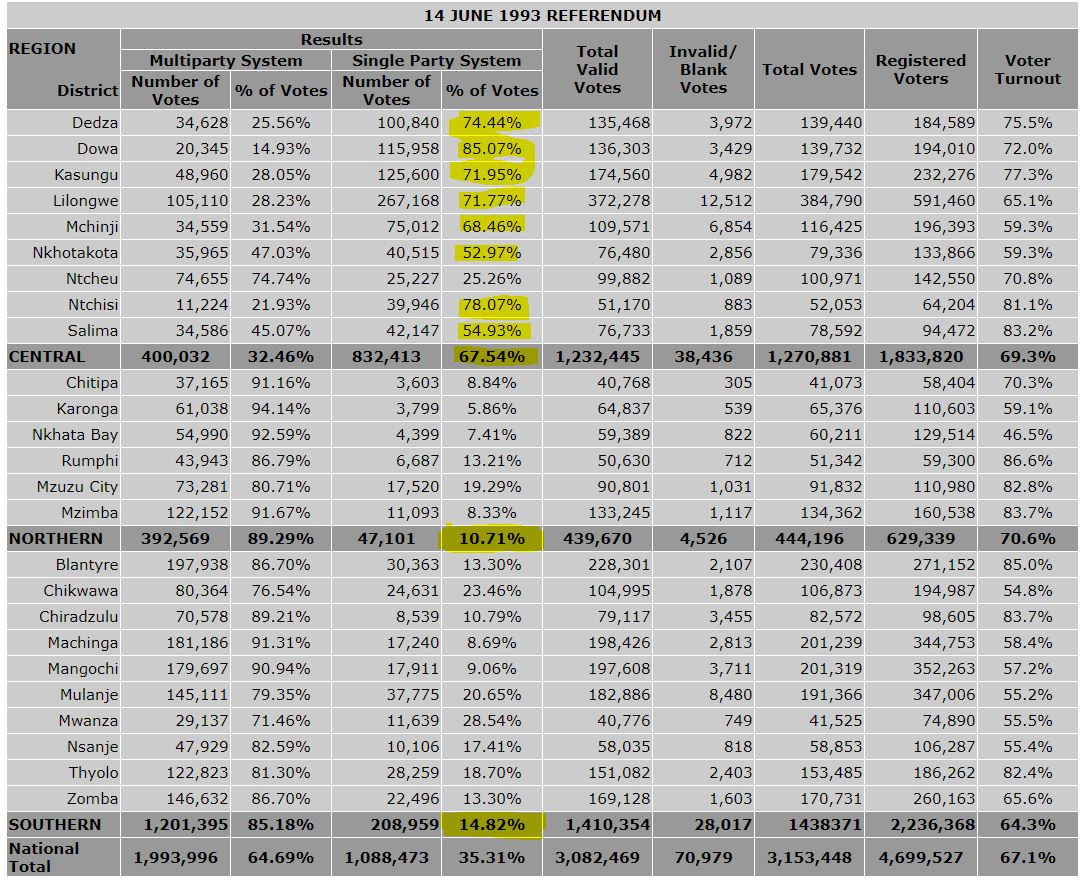
For the record, Most Chewas voted against multiparty politics in the early 90s, they also overwhelmingly voted for MCP in the following general elections - meaning to say - they wanted Kamuzu Banda to stay on.

As a matter of fact, no matter what any other candidate says, the Chewa block always largely votes MCP nonetheless. They are a tribal cabal by definition.


When the Mutharika dynasty rose up and plunged Malawi into another sunken phase, Malawians rose up again from Timothy Mtambo, who can barely speak Chichewa, to Winiko. Malawi rose up again and won.

As soon as MCP got back in power, it seems the old thinking still exists.

Many people are comparing the latest move by the Chewa body to Mhlakho wa Ahlomwe, they are wrong. What the Lhomwe were doing was just them trying to do what the Chewas started back in the Kamuzu days. The Chewa wrote the tribalism book.

So, what do we do now? Well, Chewas will not change in our lifetimes, they are always going to feel like the rest of us are deputy Malawians, after all we speak their language, when one googles ‘Malawian culture,’ their Nyau comes up. Let them be, the solution to the folly lies in two things that you might not be thinking of: A strong UTM and 50+1!

As soon as they try to make Malawi a Chewa project, UTM should get out of the Tonse Alliance and band with another party that will starve them of the votes needed to make government in the 50+1 system. Let them be MCP/Chewa and let them face the rest of the country at the ballot.

Maybe it is a mistake to pretend that they are superior. Maybe it is time someone got an injunction against teaching Chichewa to nonChewa people. Maybe it is time we made all languages in Malawi official.

Give us dictatorship - Chewa voting patterns in 93 Referendum

You see a Chewa man can live in Nkhatabay for forty years and not even learn the local language because they feel others must bow to their culture. When someone speaks Chichewa with Yao or Lhomwe accent they also get laughed at because you see, you can never be Chewa if you are not.

Time to end the hegemony. If they want a kingdom, we can split up the country, it's not like we would mind not being in the same country with our Nyau-wearing, rat-eating neighbours. What will we lose?  

If they feel this is their country, then we can let them have it. 

The truth is, Chewa districts harbour some of the poorest Malawians, if you go to Nsundwe it's not uncommon for Nyau to raid a market and take other people's property, they also harbour some of the biggest illiterate folk and we saw how they needed a whole 21 point to enter college under quota. 

Instead of trying to band with the rest of the country to uplift the nation and make it better, they don't want to leave their 1800 thought behind. Some are very proud to be ignorant and the entitlement of some is sickening. They behave as if everyone in Lilongwe or government should pay homage to the Chewa landowners and kings. 

Politicians love them poor, ignorant. They lionize Kamuzu Banda and make them blindly vote MCP because they are promised entitlement. They believe that they need to be fed and petted like precious dogs. 

Someone had to say it.

Disclaimer: I am not a subject of Gawa Undi, in fact, fuck Gawa Undi and he can send me his CV, I am out of tissue paper. 


Friday, May 8, 2020

Here is the Supreme Court Ruling Upholding the Constitutional Court Ruling that Ordered Fresh Elections in Malawi

An election was held in poor Malawi in 2019, Peter Mutharika won by the narrowest margin, the others MCP and UTM challenged the 'win' in court, the Constitutional Court agreed with the 'others' and ordered a fresh election... Peter Mutharika of DPP  in cahoots with MEC [strangely] appealed the said court decision at the Supreme Court, the highest court there is in Malawi [in case you didn't catch the 'supreme' reference]. The Supreme Court has just delivered its verdict [on 8th May 2020]... it has agreed with the Constitutional Court and upheld its verdict. This means Malawi will have to hold new elections and go with the 50+1 system. It also means the Malawi Electoral Commission (MEC) was indeed weighed and found wanting.

Read the full verdict here. You will have to download the PDF.


Saturday, May 14, 2011

Kamuzu Must Die From Malawi’s History- Celebrating Him Is Satanic

By Bright Mhango
Hastings Kamuzu Banda, to some Malawians and Africans, was a statesman worthy emulating and that he has to be celebrated and given a special place in Malawi’s History. To others, like me, celebrating Kamuzu is like re-installing Adolf Hitler as Germany’s Chancellor. In this rant, I will raise reasons why Kamuzu should only be celebrated by witches.
I will start by dispelling the myth that Kamuzu was the one who fought for independence for Malawi, and that he was a good man.
When the four Young Turks; Masauko Chipembere, Dunduzu and Yatuta Chisiza, Kanyama Chiume plus Orton Chirwa launched their opposition against the 1953 Federation of Nyasaland and Rhodesia, Kamuzu was in England. He refused to come to Malawi fearing that his extended family would prey on his money even though Nyasaland had paid part of his fees for him to become a doctor in Malawi.
It was only after he was sued for impregnating his secretary, Mrs. French in England and given marching orders in Ghana for operating an abortion clinic that he came to Malawi. There was nothing patriotic about his refuguish move.
The likes of Masauko Chipembere were doing just fine, the reason they invited Kamuzu was because he was old and thus instrumental in convincing the chiefs that didn’t take the Turks seriously when they preached independence.  Chipembere and Chisiza had already made their names as daredevils and the Hansard was selling like porn because of their revolutionary statements in the white dominated Legislative Council.
It was the young Turks who paraded Kamuzu around Malawi and gave him the post of MCP president on a silver platter. The Turks are the guys that wrote his swaying speeches and did some of the translation; yes translation, because the Malawian who wrote about his tribe in America did not speak his own language.
With the Vocal Turks, Operation Sunrise soon landed Kamuzu and his three mates at Gweru Prison in Zimbabwe where they laid out plans together. When Kamuzu was released and toured the world in the name of leader, his friends languished at Kanjedza. Kamuzu delayed securing their release to make political headway, finally releasing them on the day of the MCP convention in Nkhota Kota where he was made Life president of MCP.
They chanted down the British Babylon together and soon they won independence but Kamuzu wanted all the power; keeping a firm grip on six key ministries and not respecting the Turks and friends in public. The Turks felt like the rest of the Animals in George Orwell’s Animal Farm. They fought together and the pigs wanted it all?
It was only natural that the Turks, just like they did with the ‘Bush Meeting’ that sparked Operation Sunrise, meet again - producing the Kuchawe Manifesto that ultimately sparked the Cabinet Crisis of 1964. It was not even a crisis, the ministers wanted to check Kamuzu’s unjustifiably huge powers. Naturally Kamuzu refused and a vote of no confidence was proposed against him.
 Of course Kamuzu tricked the parliament and stayed on in power, he fired the ministers and the anarchy started.
Orton Chirwa and wife Vera were rewarded with a death sentence becoming Africa’s longest serving prisoners of concise. Dunduzu Chisiza was found dead on the Zomba-Blantyre road, Yatuta was betrayed by his Greek buddy and gunned down, and Chipembere went into exile.
Of course, the court did not find any evidence to nail Kamuzu for the Mwanza murders but what did you expect? What do dictators do with evidence?
As if that is not enough, Kamuzu took a queer attitude towards people from the districts north of Nkhamenya, who for lack of a better term, I will term Northerners. The only crime these people seem to have committed was to embrace Scottish education especially as pioneered by Dr. Robert Laws at Khondowe.
What followed was the banning of ChiTumbuka from MBC and The Daily Times at the onset of the 70’s. I once spoke to Manjawira Msowoya who explained how he and his fellow Northerners were booed at MBC by workmates after the ban was announced, you should have seen the look on his face.
Studies by the likes of Noam Chomsky and Ajit Mohanty suggest that tribal children learn better in their mother tongue at basic level, this was what was going on in Malawi with ChiTumbuka being taken up to JCE level in Tumbuka areas.  Kamuzu pulled out Northern languages from the Syllabus and had all the books burnt.
Tongas and Senas had to study ‘Maliro Ndi Miyambi ya Achewa’ as if they had no funerals and customs. I know a teacher who was slapped for teaching in ChiTumbuka soon after the ban and the church elders at St. Peters Parish in Mzuzu were nearly arrested for preaching in ChiTumbuka.
Unfortunate for the North, 80% of the police stations were filled with Chewa speaking officers to partly enforce the ban and to check rebels. Even today, villagers are forced to speak in Chichewa when being interrogated or giving evidence.
To come from the North was suddenly a problem to Kamuzu; led by John Tembo late in his rule he brought on the Quota system to check the numbers of Northerners in secondary schools and colleges. Brothers and sisters had to shed ‘Northern’ names to adopt those from the Chewa speaking tribes to stand a chance.
Call it what you may but the 1980s deportation of teachers of Northern origin to the North was the most traumatising. It was not just teachers, hundreds fled across the borders and their crime was the same, being Northerners.
If not for a Mr. Jungubawa felling a tree onto the road leading to Livingstonia’s water source, a government 110 defender full of poison would have accomplished its mission. Livingstonia by then was fully behind Chakufwa Chihana’s revolutionary messages.  Of course none of you cares about that genocide attempt, but I do, I was there in Livingstonia. And thanks to the likes of November and Paul Jungubawa, that 110 Defender was evenly smashed and popularity for Chakufwa Chihana trebled.
As if that is not enough, Kamuzu made speeches calling an end to regional discrimination to ironically call for it. While he splashed millions on his pet capital city, he swore not to develop the North and called people from their ‘Rebels.’
My grandfather at Mlowe, the home of Kamplepo Kaluwa and myself, told me that the lakeshore road had to be diverted at Chiweta to pass via Phwezi and Mzuzu to avoid developing the Mlowe and Nkhatabay areas because they were the homes of some of the so called rebels, in fact the so called Northern Corridor was only sanctioned after war in Mozambique made Nacala a bad route. Why such passion at hating and for what? Being a Chirwa or a Chiume?
 I have come to be Northerner because of Kamuzu. My friends are from Lilongwe, Dowa and I from the North. I cannot speak my language elsewhere in Malawi or people will call me names. I am certainly not going to get employed in some companies because I am from the North.
Kamuzu crushed dissent like lice. Good journalism was a crime. Pollock Mhango was detained (1981) for seven years and beaten mad for writing; Mkwapatira Mhango was bombed (1989) in his house killing him, his two wives and five children. This was just after Kamuzu said that facts of his lavish official hostess were being leaked to international media by Mkwapatira and family. Maybe, you cannot feel the gravity because you are not a Mhango.
We cannot pin down what my distant grandfather, Matchipisa Munthali did to deserve 27 years behind bars, or why Atati Mpakati lost, first his fingers, to a parcel Bombing and later his life in a KGB style assassination.
People lived in fear under Kamuzu, I remember being with my grandmother, NyaChikoko when Kamuzu death was announced, she sighed and told stories of how her house was forcibly used as a guest house by MCP officials and how drunkards were clubbed to death by the Malawi Young Pioneers for behaving in a rebel manner.
Miniskirts and long hair were banned while our friends in Jamaica and USA enjoyed hair and bare thigh. Though I was young, I recall how jittery people were at the passing of a plane believed to be carrying the Ngwazi or at the chime of the national anthem. Only the rare breeds partied and gardened during public holidays. Was that not a gaol of some sort?  Smells like Taliban controlled Afghanistan to me.
Yes, you remembered the Youth Week! Good as its intentions were, the implementation was via Chinese channels and that part hurts a lot.
The saga continues
Kamuzu Banda was the only Black Person that thought Apartheid was good. When everybody was breaking ties with South Africa, he was busy strengthening trade links. Here is a guy who criticised the Federation and called for independence of Malawi.
If you are reading this from Lilongwe you should know that you are in the blood city, it was built with funding from the oppressive South Africa. In addition, Kamuzu said at the OAU that Egyptian planes that were scheduled to start bombing South Africa should not pass through Malawi.
Banda’s hypocrisy also played out in Mozambique where he supported both the oppressive Portuguese government and the rebels? How sick is that? Supporting both Renamo and Frelimo resulted into Malawians killing Malawians sometimes as they were in both fighting sides.
The Britons asked to build Bangula dam, which would have been bigger that Sudan’s Gezira Damn but using lame excuses such us the fear of Bilharzias, Kamuzu rejected the move effectively assuming responsibility of today’s blackouts.
Personal enrichment is also another noxious thing about Kamuzu, coming to Malawi as a broke sex scandalist with a medicine career begging to be banned, he died with wealth estimated at half a billion US dollars.  Why the past and current governments haven’t properly looked into his wealth is a question for all of us to ponder on.
This is the guy who clashed with Orton Chirwa on the pace of Africanisation in the 60’s, what does he produce as a solution? Kamuzu Academy. Taking 80% of the budget allocation to education to set up a school that taught Latin and Greek. Did Malawi not need a hundred MCDEs -as they were called?
The guy was a schizophrenic, its why he dubbed himself the mouthful title ‘His Excellency The Life President (Paramount Chief) Dr. Hastings Kamuzu Banda,’ thirteen years before his death as quoted in The Independent of UK on 27 November 1997, said “Government here means Kamuzu. Kamuzu is Malawi. So be frank when speaking about government. You know you are speaking about Kamuzu, that’s all whether you like it or not.” Is Malawi Kamuzu now?  So this is where Muluzi copied his “afune asafune” phraseology?
All I have been trying to say it that when you celebrate Kamuzu, when you let people that pioneered his policies like John Tembo and when you give respect to queer questionable women like Cecilia Kadzamira, you make some of us shiver. I was shocked to hear that Tembo is now a church elder but I know that’s typical of the church, even Pope Benedict backed gay molesting priests?
When you build grand mausoleums for dictators, adopt their names, policies and name landmarks after them, you make us remember what we are trying hard to forget. I wonder if they have a street named after Hitler in Germany.
Yes we know to many of you he is a hero, of course he is the guy that made you rich, that made your culture and language official, that gave you the ‘elite’ status among your fellow Malawians but if I am to belong to Malawi, it should be that without big brother posters looking down on me and reminding me of the Nazism that I, my kind and others have been through.