Showing posts with label blantyre. Show all posts

Friday, August 21, 2015

The Thousand Jesus Mountain

Certify this hill holy!

I have been to many holy sites, the Hanging Temple in Datong China or China’s holiest mountain top Mount Tai in Shandong Taian, but I have never seen holy at the level of this small-time mound on the south end of Blantyre urban.
The New Jerusalem - a Temple up Soche Hill

I was not sure of going up the hill, I was not sure it was safe, I had to hide my camera in a black bag and kept looking over my shoulder as I started to hike. I was wrong.

The hill was filled with men women and children, mostly women. All of them were in the hill to placate or praise God via Jesus. I am sure there was no Muslim there.

Everywhere I looked, I saw a person or a group of people. They were singing, dancing, pacing to and fro while swinging their arms, shouting and invoking the Holy Spirit.

Bush fires have ravaged most parts of the hill and as I meandered through the ashy paths and heard one woman shout “Fire! Holy Ghost Fire!” I wondered if it was this holy fire that was scorching the flora on the hillsides.


I went there to hike
I saw a trio of guys holding hands and praying, then break into song, then kneel in incessant prayer… as a non-believer, I was outnumbered a thousand to one at Soche hill.

One guy was on the very top, walking to and fro, appearing briefly on the cliff from where I stood below, as much as I knew he was only praying, it looked as if he was some suicidal guy gathering momentum and courage before leaping to his demise.

I saw a tent, with some youths singing joyously near it. I saw a cave with women peeping from the dark hole and a pastor dishing out the word on the mouth.

I saw a cross enclosed in a stone hedge, like a site from a movie set in ancient Israel. I saw someone cooking and another washing dishes by a spring, again I wondered if it was these fires that were to blame for the fires that plaque the hill.

I saw verses and Biblical terms scrawled on rock faces, ‘Shalomo,’ shouted one line, obviously greeting me the way an Israeli would, without the “o.”

Jehova, Shalom, El Shadai and Jehova Shama, I believe
As I knelt by the spring to tap from the indisputably clean water, a woman offered me a cup from her stack of dishes, I refused her offer but could hear the holiness in her offer, everything in this hill was like a huge Christian camp full of what Adventists would call ‘Philadephia.’

Not all was Philadelphia, every grouping represented a particular grouping, on one mass Sermon on the Mount. There were like ten groups visible to me from where I stood observing.

I went hiking for fitness reasons, seeing as how rare it is to find a playground to play on around the residential areas, instead, I discovered one of the rarest phenomenon I never expected to find here in Malawi a country that was unware of Jesus at the start of the 1900s.

I visited this hill around 2pm on a Tuesday. Do these people have jobs? Or do they go to school, these youths? I kept thinking. Are they here following some serious tragedies in their lives or is this all SOP in their Christian lives?

I felt evil, I have never pursued faith this seriously, and maybe it is why I lost it. Now I believe in Bandwidths and theories of old white men. Sigh.

I did not disrupt anyone, I kept my distance, I used my full zoom to take my pictures but I came close to one group.

You add the Caption...they are in deep prayer
The pastor was shouting ‘this water is holy!’ while sprinkling it on some hypnotized women. I watched with keen interest, the pastor told the women that they were free. They broke into song and after a while one woman told the pastor about her brother who was not coming home.

I did not stick around to hear how he helped this woman, would prayer really bring back a guy who has gone rogue on a drinking spree?  Or maybe the best way is just to wait till they get broke like the prodigal son did in the Bible?


And it is not just Jesus that is the darling of the hill, Rastafarians from the city also occasionally congregate here. Which gives me another idea as to what causes bush fires, you catch my drift? 

I was at the foot of the hill and just before I exited the bush into the neighborhoods, the woman in front of me stopped and issued a final prayer, I stopped in their midst and joined them in prayer.

I was dirty from the sooty bushes and the dusty paths, I looked down on my feet and I did not look like someone who was n holy ground. Maybe, like Moses, I need to take off my shoes next time.


Wednesday, November 7, 2012

Fighting HIV one family at a time


Twenty seven years of HIV and the nation is still buckling under the weight of the pandemic, by December 31 fifty thousand fresh Malawians will have contracted HIV despite the various interventions that are being implemented…there is one intervention, however, that looks like it’s the panacea the nation has been waiting for.
The Kantuwanjes  -  enjoying their hakuna matata married life
 Jonas Kantuwanje, 44, teaches standard three at Mdeka Primary School, some thirty minutes outside Blantyre city, in his spare time he plays technician and fixes radios and televisions that people bring to him, as he works, his young wife Brenda, 22, potters about and the new-born baby in the house serves as an icing to the harmony.

Kantuwanje’s first marriage collapsed years ago and when he thought of remarrying his prime worry was HIV, back in his youth days the pandemic was not as menacing as it is today. He went on to marry Brenda anyway. 

Meanwhile Brenda was also wary of the same worry as her new man. For a man with two children coming to her, she could easily be an innocent victim of HIV.
“There was this silent tension in the house, each one of us silently worried and wondered if the other had HIV,” said Brenda.

Kantuwanje said that he knew that he could get tested at Mdeka Health Centre but the distance, and the fact that sometimes there were no test kits at the health center made him lazy.
Then came the light.
Dapp field officers counsel teens at Mdeka before testing them for HIV.JPG

From the blue, the group village headman, GVH Kabano called a meeting and announced that there would be HIV testers and counselors going round the village to provide what both Brenda and Jonas secretly wanted.

“They came to our house, counseled us and told us of the benefits of knowing our HIV status. We agreed and we were tested. It was a big relief to finally clear the mist between us. You see, after I knew that I was HIV negative I would never dare go out to another woman, I want to keep my status the same so I can say the testing made me responsible,” said the husband.

The wife also beamed and says that the two now live happily because there are no doubts. Well, no wonder a child soon appeared in the family.

The people that tested the Kantuwanjes were field officers from DAPP. Yes you read that correct, DAPP. It stands Development Aid from People to People and not sellers of second hand clothes. Of course, they do sell second-hand clothes but they do many other things too.

The programme that saw the Kantuwanje’s get tested in their backyard is called Total Control of the Epidemic. It is bankrolled by the National Aids Commission (NAC) and the United states Department of Agriculture. 

The field officers go door to door registering people, mobilizing each individual to an individual decision on HIV prevention and ultimately an HIV test.

Madalitso Chimtengo is one of the fifty field officers that DAPP employed for the door to door HIV testing and counseling exercise. He was assigned to test 4000 people in several villages in traditional Authority Chigalu’s area which occurs in Blantyre North. He gallops from one village top another on his mountain bike.

Chimtengo starts by noting that since the programme started three years ago, there is a visible behavioural change as those that have been tested are now responsibly living.  Already out of the about 3600 he has tested only just above 50 have HIV.

I asked him how he manages to beat the strongly held fears about HIV testing and go on to test people in their homes.

“Well, firstly, chiefs rallied the people and told them that we would be going around and again we do not go with the message of testing, we go and ask the people what they know about HIV, if they know little we tell them what they don’t know and then we tell them the benefits of getting tested.

“There is little rejection; the response was actually overwhelming such that it is the HIV test kits that ran out while people still wanted to get tested. If this was a country-wide programme HIV would be contained quickly,” said Chimtengo.

Already at Mdeka Primary School where some field officers had set up a testing booth, children as young as 8 years had to be chased off the queue of those wanting to get tested, its like testing is the new cool thing.
Asked if testing people in the villages is not going to fuel stigma, Chimtengo contests and reckons that it in fact normalizes knowing ones status and bolsters openness on HIV questions.

Chimtengo - There is Behaviour change.JPG
Chimtengo bemoans the lack of condoms in rural areas, the lack of test kits as some of the things that stand in the way of the programme. 

Florence Longwe coordinates the programme for DAPP and reckons that the approach works because of its personal nature.

The HIV and AIDs discussions are taken at a personal level and issues are not generalized. Hence individuals open up on what HIV and AIDS issues are directly affecting their lives.  In a mass media there is no personal dialogue where one can freely open up issues which are affecting them.

“TCE programme sees family as an important entry point for preventions, for stopping stigma and discrimination and rallying support for positive living for those on treatment. It is reaches out to people at their own convenient time and at the same time also those who find it difficult to go for such services due to transports or distance restrictions,” said Longwe.

She said the door to door makes it easy to reach men who usually do not go to clinics to get tested. Out of the tested in the TCE pogramme, 46 percent are men. 

 The project also has potential to reach more married couples who are the main culprits in the spread of HIV today, it difficult to find couple together unless they are at home. Again couples who are HIV negative or think they are because they don’t fall sick will never go to a hospital for HIV testing a gap that the TCE programme effectively fills.

And it is not just testing and counseling.

The project was phased out on October 31 but the Chimtengo said its effects will ring and stick around forever. Each field officer has trained volunteers in the villages who will take over the counseling in prevention, nutrition for the infected and the follow ups on all the rest.

For every HIV positive person, the field officers organised two family members who are supposed to check on the infected making sure that they faithfully adhere to their Anti Retro Viral drug dosage. Some members are trained in vegetable production while some were given heaps of shoes and the returns from the shoe sales are meant to economically help the infected. 

Gift Chitukula another field officer who also has tested over 3000 villagers proudly  declared  that he does not have more than 200 on his list that have HIV and this apparent low prevalence of HIV excited T/A Chigalu.

“I think the fact that we have been speaking and prioritizing HIV and testing has made people start to actually listen and change their behavior, already some bad cultural practices that fueled HIV have been eliminated, we have even banned overnight Kitchen top-ups which were new platforms of immorality,” said Chigalu.

Dapp field officers counsel teens at Mdeka before testing them for HIV.JPG
The programme is also being implemented in the low income areas of Blantyre and Thyolo. It was rolled out in 2007. There are about 25 field officers and each is supposed to test, counsel and follow up on 4000 people in three years. 

That is first to register and know them, then to counsel and or test then check of them later to make sure that those without the virus do not get it and that those with the virus do not spread it and are living healthily.

The Kantuwanjes can now enjoy peaceful sleep and as the Chimtengos and Chitukulas pack their utensils and leave T/A Chigalu’s area, the onus is on the community (over a million reached so far) to keep the sanity that the TCE programme brought.

Saturday, August 11, 2012

H2 All: The Equation of Life and Death


What does a community perched on a hillside with no water do? If your answer was “relocate” you would get half a mark because the real answer is ‘die.’ For the Nawotcha community, however, they chose never to die nor relocate and through some genius and altruistic moves of a few, everyone is happy and well watered.
The upper part of Nawotcha and Chilobwe in Blantyre has been without piped water since piped water begun, all along the communities had to rely on water that naturally occurs on the leeward side of Soche hill, the water was seasonal, murky and soon the boom in population mated with the decline in tree population along the hills saw the water drying up. 
To get water, one has to get further up the hill.
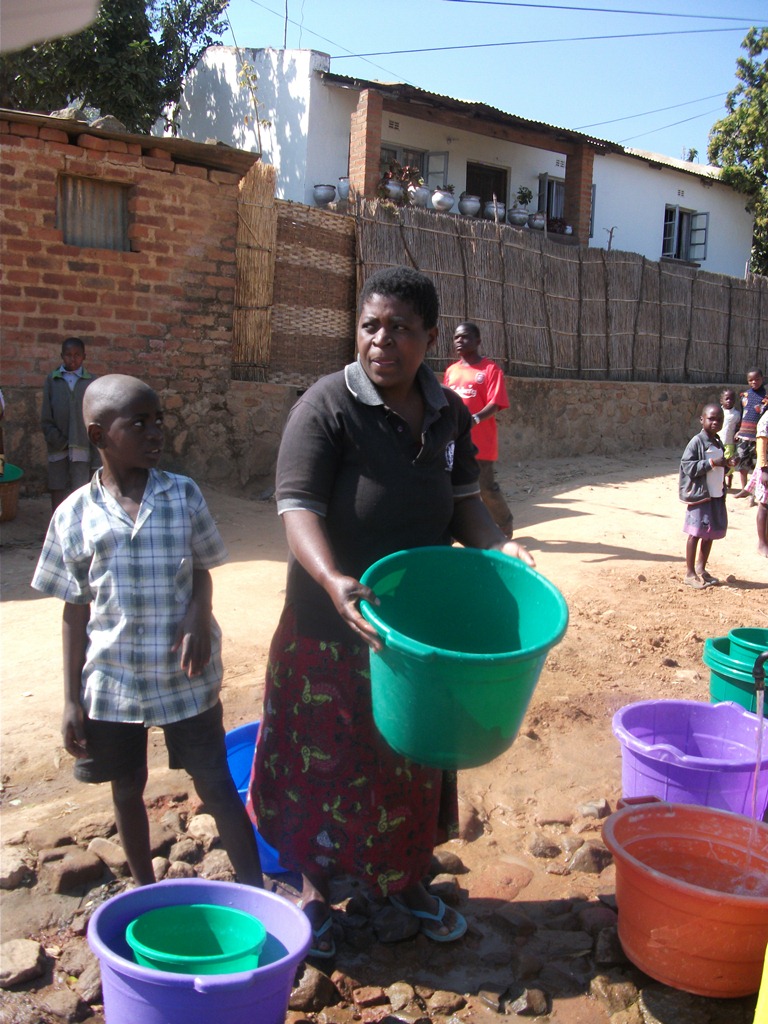
Woman draws water at Tchinga's kiosk
“We would go up there in the hills at night to draw water because during the day there would be many people and some would fight over who gets to draw water first,” said Fagesi Tchinga a longtime Chilobwe resident.
Blantyre Water Board has not even bothered to get its pipes near the area, maybe because most families there are generally poor or because the topology of the area is forbidding, we will never know. What we know is the people were caught between hard rocks and dry wells.
Joel Tchinga, husband to Fagesi Tchinga the woman who spoke earlier in this story, narrated the story of Nawotcha’s bad water days. He spoke from his house, which is one of the very last before Soche Hill becomes uninhabitable due to steepness.
The house is sandwiched in between huge rocks and right in his courtyard grows a Mubanga tree, a tree one would find in a real jungle and yet here 15 minutes from Chilobwe Centre it stands.
“It started as a political thing, Mr. Magwira and Mr. Chimombo wanted to be elected as councilors so they brought the idea of bringing water from up the hill, it was part of their campaign moves,” said Tchinga.
The two never got elected but their idea of harnessing water caught on among some people and so Tchinga and about eight other people invaded the hill.
Tchinga and Fagesi: Messiahs or Business People?
Each person of the eight lays his own pipes, each person has his ‘own’ spring, and each person has his own water kiosk where they sell water to the rest of the community.
Tchinga has two water selling points, one is watched by his son and the other has an employee. For anyone to tap 20 liters of water, they part with K15 and according to the family one tap turns over about K1000 per day. 
“I have two children in private schools, another is in college, I have put Iron sheets on my house and the rest greases the running of this household and if a senior loafer like me boasts of being alive, it’s because of this water,” said Joel, stroking his long grey goatee.
He has worked  as a watchman in several big companies since a living in Blantyre in 1980 from his home in Nchalo, he has lived in Blantyre long enough to own some land amongst the stones of upper Chilobwe where he has built some houses that he rents out. It is from this rent that he got the funding for his water project.
The water is tapped from natural spring about two and a half kilometers from his house this because he said he laid about 600 pipes each stretching four meters. He placed some cement around the spring and channeled the water into his pipes. No pumps, no damming.
The water comes straight to his house from where it goes to about 10 private customers and the rest goes to the selling points where women crowd around to fill their water canisters.
It’s not been an easy road for the Tchingas; many times than they can remember thieves have stolen their pipes that lie plastered on the hills. The family had to go into debt just to replace the stolen pipes.
“They stole my pipes so many times that I wanted to quit but I told myself not to not just because we find soap from the water but because we need the water, one night the water suddenly stopped i went up there with a weapon am not going to reveal here and missed one of the four vandals by the hair, since then my pipes have not been stolen again,” said Tchinga
Fagesi, the wife, said the coming of the water means little headache because the place she used to draw water from was far and that the water was not clean especially after the rains.
Confronted on the quality of water the family reticulates to the community, the Tchinga’s insist theirs is one of the best water flowing out of Blantyre taps because it comes from a hill that is not inhabited and is filtered by the rocks before going into the pipes.
The family said they have special days that they go to clean their water source but ruled out using water purification agents saying if they apply chemicals they go right down since there is no dam. The water source has also been covered [reportedly] so nothing can fall in.
We needed water: Tchinga

The hill is fast losing trees and just like the springs they used to draw water from, the existing springs are on their way to extinction if the rate of trees being felled continues; a thing that substantially scares Tchinga.
“The sustenance of the spring is at God’s mercy, he can dry it even tomorrow but as for the trees, it’s true that they are fast going and that the hill is drying since the trees provide shade to the water,” said Tchinga.
He said his and his fellow water providers formed a committee that tries to replenish and re-afforest ate the hill saying they plant up to 2000 seedlings per year but said it’s not enough since wanton felling of trees goes unchecked.
He said though there are guards to check tree felling, some community members go and fell trees at night and some go in the day and bribe the watchmen. Him and his fellow water providers do not have the legal mandate to patrol the hill or to stop anyone from felling trees since the hill is under the government.
“In the near future we want to be more aggressive in protecting the hill, we will decide how in our committee and take our proposition to the forestry department.”
Demand for the water goes down sharply when the rains touch down, households get their water from the many seasonal springs that pop up on the hill’s foot. Some trap water from their roofs but when October comes demand for Tchinga and Company’s water goes through the roof.
“People come this side from Chilobwe Centre especially when the Blantyre Water Board stops flowing, but the problem is that when October comes, our water pressure also drops after all my pipes are only two inches wide as you saw,” said Tchinga.
But a drop in water pressure is better than living in Zingwangwa in some adjoined houses with no pit latrine and yet with water flowing only from about 11pm. When water stops flowing in this part of Zingwangwa women remember their days in the village because they have to travel long distances trying to sniff for taps that are still running, in Bangwe, its worst.
Water is life
The latest Joint Monitoring Program Report by UNICEF and World Health Organization, states that 95 percent of people in urban areas and 80 percent in rural areas have access to safe water. This statistic is however contested by the charity Water for People - Malawi which says the de facto water situation in the 21 low-income areas of peri-urban Blantyre is that only 62 percent of people have access to water that meets government standards.
Blantyre Water Board will probably never bring their pipes to upper Nawotcha  and the natural spring is not likely to dry up in the next three years and during this period, people of Nawotcha  will not have water induced headaches but it all a time bomb and when the springs dry you will hear from Tchinga again.
Tchinga, Mazonda’s son, Chimera, Zaina, Mpazula and Chimombo are not names that one will hear during any awards ceremony in Malawi but what they are doing in Chilobwe -  that is using personal resources to bring water to hundreds of households -  is the type of action the dictionary calls heroic.


Sunday, July 17, 2011

20 July Demos Just Got Bigger, Zomba & All Districts Now In - Blantyre Route Changed Agian

On The 20th July, 2011 National Peaceful Demonstrations 

This is to inform all Malawians and various stakeholders that we members of the Civil Society and concerned citizens have organised peaceful demonstrations to take place on 20th July 2011 in all the four regions namely: Southern, Eastern, Central and Northern Regions and all Districts from Nsanje to Chitipa.

The peaceful demonstrations have been organized as part of our constitutional right to express alarm regarding the current economic and democratic crises facing Malawi, with the aim of calling for an end to the current poor economic and democratic governance being advanced by the current administration.

The Theme of the Demonstrations is:  Uniting For Peaceful Resistance Against Bad Economic and Democratic Governance – “A Better Malawi Is Possible
Outline of the Demonstrations is as Follows:-

Southern Region
Starting point: - Start from the Clock Tower in Blantyre thence to the Blantyre District Commissioner's Office to deliver a petition to the DC and ending at the gates of Sanjika Palace where another petition would be delivered for the attention of the State President.

We are calling all Malawians from Ndirande, Chilomoni, Chilobwe, Bangwe, Zingwangwa, Machinjiri, Mbayani, Chileka, Ludzu, all areas and locations to join the demonstration on 20th July.

Eastern Region: - Demonstrations will be conducted in Zomba City and we are calling Malawians from all Matawale, Chinamwali, Nsazi, Itiya, Ndola, St Marys, Chikanda, Mpondabwino and other areas and location to come and join this peaceful demonstration.

Central Region

Starting Point: - From Community Centre Ground through Old Town then Kasungu Highway then to City Centre where speeches will be made.

We are calling all Malawians from Area 25, Kawale, Biwi, Mchesi, Chinsapo, Area 23, 33, 49, 39, Bunda, Likuni,Mugona ,all  Areas and Locations to join the demonstration on 20th July.

  
Northern Region

Starting Point: - From Katoto Ground through Town to City Assembly Office where a Petition will be presented.

We are also calling on all Malawians from Zolo Zolo, Katawa, Chiwanja, Mzilawayingwe, Chasefu , all Areas and Locations  to join the demonstration on 20th July.

District Demonstrations: - Malawians demonstrating in districts we appeal to you to convene at one place and March to the Office of the District Commisioner to present a Petition.

Colour: - We are appealing to all Malawians to put on anything RED on 20th July wherever they are for this peaceful demonstration. 

If you cannot join and you are a Chief Executive,  Managing Director,  or any other Officer , or working in the Police, Army, and if you are a Civil Servant please release your house servant/gardener on this day of 20th July.

If you are not going to join the March can you whistle, hoot you CAR  and beat drums wherever you are while dressed in RED.

And as a silent protest STOP watching Malawi Television and listening to MBC as it is a source of misinformation, hatred and division against peaceful Malawians.

Note:  This is a peaceful demonstration and we would appeal to all Malawians to be DISCIPLINED during these national wide demonstrations.   Lets us show the authorities that much as they are oppressing and victimizing us we are peaceful and responsible Citizens.

This is your chance to make the difference by being heard and be counted on 20th July.  Starting time is 8 :00 in the morning

Lastly we sincerely thank the Business Community, Government Officials, Democratic Peoples Party Officials, the Police, Army, City, Local and District Assemblies for the support and understanding   and we look forward to successful and peaceful demonstrations.

COME ONE!  COME ALL! 

“A BETTER MALAWI IS POSSIBLE”

VIVA DEMOCRACY! 

VIVA STRUGGLE AGAINST OPPRESSION AND DICTATORSHIP!

Friday, July 15, 2011

Change Of Demo Route For BT, Plus Demos Now To Cover Whole Malawi

"Dear Readers, Note That Blantyre Route Has Changed"

On The 20th July, 2011 National Peaceful Demonstrations 

This is to inform all Malawians and various stakeholders that we members of the  Civil Society and concerned citizens have organised peaceful demonstrations to take place on 20th July 2011 in all the four regions namely: Southern, Eastern, Central and Northern Regions and all Districts from Nsanje to Chitipa.

The peaceful demonstrations have been organized as part of our constitutional right to express alarm regarding the current economic and democratic crises facing Malawi, with the aim of calling for an end to the current poor economic and democratic governance being advanced by the current administration.

The Theme of the Demonstrations isUniting For Peaceful Resistance Against Bad Economic and Democratic Governance – “A Better Malawi Is Possible
Outline of the Demonstrations is as Follows:-

Southern Region
Starting point: - Start from the Clock Tower in Blantyre thence to the Blantyre District Commissioner's Office to deliver a petition to the DC and ending at the gates of Sanjika Palace where another petition would be delivered for the attention of the State President.

We are calling all Malawians from Ndirande, Chilomoni, Chilobwe, Bangwe, Zingwangwa,Machinjiri, Mbayani, Chileka, Ludzu, all areas and locations to join the demonstration on 20th July.

Central Region
Starting Point: - From Community Centre Ground through Old Town then Kasungu Highway then to City Centre where speeches will be made.

We are calling all Malawians from Area 25, Kawale, Biwi, Mchesi, Chinsapo, Area 23, 33, 49, 39, Bunda, Likuni,Mugona ,all  Areas and Locations to join the demonstration on 20th July.

Northern Region
Starting Point: - From Katoto Ground through Town to City Assembly Office where a Petition will be presented.

We are also calling on all Malawians from Zolo Zolo, Katawa, Chiwanja, Mzilawayingwe, Chasefu , all Areas and Locations  to join the demonstration on 20th July.

District Demonstrations: - Malawians demonstrating in districts we appeal to you to convene at one place and March to the Office of the District Commisioner to present a Petition.

Colour: - We are appealing to all Malawians to put on anything RED on 20th July wherever they are for this peaceful demonstration. 

If you cannot join and you are a Chief Executive,  Managing Director,  or any other Officer , or working in the Police, Army, and if you are a Civil Servant please release your house servant/gardener on this day of 20th July.

Note:  This is a peaceful demonstration and we would appeal to all Malawians to be DISCIPLINED during these national wide demonstrations.   Lets us show the authorities that much as they are oppressing and victimizing us we are peaceful and responsible Citizens.

This is your chance to make the difference by being heard and be counted on 20th July. 

Lastly we sincerely thank the Business Community, Government Officials, Democratic Peoples Party Officials, the Police, Army, City, Local and District Assemblies for the support and understanding   and we look forward to successful and peaceful demonstrations.

COME ONE!  COME ALL! 

“A BETTER MALAWI IS POSSIBLE:”

VIVA DEMOCRACY! 

VIVA STRUGGLE AGAINST OPPRESSION AND DICTATORSHIP  !