Showing posts with label poverty. Show all posts

Wednesday, January 30, 2013

Malawi frees all witches from jail


It is unprecedented. Malawi has freed from jail the last prisoners who were incarcerated for allegedly practicing witchcraft.

Thindwa posing with the two "witches"
Liviness Elifala, 51 and her friend Margaret Jackson who looks 70 of Lodzanyama village, Traditional Authority Ntema in Lilongwe rural, some 40 minutes drive from the Lilongwe City Centre have not been home for the last three years.

The two have been in prison for three years and just returned about two weeks ago following the latest presidential prisoner parole.


Elifala found her house dilapidated, the planting season is past and therefore she has no food now and will still have none after the harvesting season.

“Some children told their parents that we had enrolled them in which craft school, their parents and chiefs ganged up on us accusing us of which craft, we did not want trouble so we admitted doing it though I had no idea what they were talking about, we taken to Kanengo Police where I spent about two weeks in a cell,” said Liviness, who did not flash a small the whole time she talked.

One informant in the village said the two used to magically get children in the village to magical soccer games where the ball was human heads.

And that was the end of the two women; the court found them guilty and sentenced them to five years in prison.

Elifalas belongings she has to start a life with
How a whole court of law  and the police used evidence provided by under-five children who based their cases on what they saw in their dreams in another story, what is known is that an Septuagenarian and her friend were thrown in jail mercilessly.

“We were never harassed in prison, except for one time when my fellow inmates beat me up,” said Elifala.
Key in the release of the two women is The Association of Secular Humanists (ASH) with its leader George Thindwa; ASH is at war with witchcraft and is currently running adverts on local radios to sensitize people against witchcraft violence.

So far ASH has bailed the women out by giving them two bags of maize each, medicine and assorted groceries and it was instrumental influencing the release of the two women by bombarding the state with petitions.

With funding from the Norwegians, ASH engaged Chancellor College Sociologist Dr. Charles Chilimampunga to determine the extent of the witchcraft problem in Malawi and the results indicate that despite the two Lilongwe ladies being freed, there is still a long way before communities let go of their view on witchcraft.

The study, released in April last year, found that 87 percent of sampled communities believe there are witches among them and that witchcraft is on the rise. Most of the accused are older women and the accusers are usually children.

“This study found that some suspected witches are subjected to acts of violence. For example, 11 (73 percent) of the 15 sampled suspects, reported that they were beaten up,” reads the report.

Thindwa hands over maize to start off  post prison life for freed witches
Apart from Physical violence, the suspected witches lose their property through vandalism are socially and psychologically sidelined and some witchdoctors have been reported to have sexually abused some female suspects.

Legally witchcraft is not recognized in Malawi and the Witchcraft Act of 1911 says it is illegal to accuse another of being a witch such that the children that accused the two women were in contradiction with the Act and were supposed to face the law.

Elifala and Jackson however got jailed because they admitted that they are witches and the same Act says it is illegal to pretend to be a witch.

“The means by which witches are identified are very dubious and questionable since they cannot be subjected to scientific scrutiny or testing. Revelations by ‘witches’ and children can be misleading since admissions by the accused are sometimes made under duress,” charges the report.

Thindwa pointed at some religious leaders especially from the Pentecostal realm who he said have been blaming things such as financial misfortunes on witches and therefore perpetrating the hooliganism that follows.

As a panacea, the report calls for a nationwide campaign to enlighten masses on what the law says on witchcraft, it also calls on the police to handle the issues of witchcraft accusations without wanton emotions and favouritism

“[there is need to] develop measures that ensure that those accused or mistreated in the name of witchcraft are able to report, come forward and speak out of injustices to police, DCs or relevant NGOs. Establishment of temporary shelter, hotline and legal support would be in order,” suggests the report.

For Elifala and Jackson however, all they hope for is to get back the life they had and to try to ignore the stares that will haunt them and the poverty that prison created for them.

Lodzanyama used to be their village but that changed in a flash when everyone turned against them over a rumour sparked by children who should be in kindergarten learning how to speak, its now just a camp.

Thursday, November 8, 2012

Negotiating the cost of giving life Joyce Banda's way


Felicia Yohane has sired four babies in her life, two of those did not live to celebrate their first birthday, two are living and now that she is 7 months pregnant, she is very aware of what can happen to her expected baby.

Felicia lives in one of the 197 villages that look to Lumbadzi Health Centre for assistance, she has to walk a long distance of about 2 hours to come to the health centre. And she is not alone; the hospital sees 160 maternity deliveries per month, 10 waiting cases per day and hoards of pregnant women coming for neo-natal care, that is the attention given soon before delivery.

Felicia’s pillar, Lumbadzi hospital however has only thirteen beds in the small maternity wing that has no waiting area, the 13 beds therefore service those that have delivered and those about to. It’s a case of hard rock and place because the next nearest health centre is 15 Kilometres away from Lumbadzi.

Felicia in a one on one with a nurse
The situation at Lumbadzi is just the summit that is visible; the real mountain spans across Malawi, almost all health centres in the country face what Lumbadzi health centre faces.

Out of every 100,000 women that give births in Malawi about 700 of them die in the process, this is high by all means, in Estonia out of the 100,00 only two women are expected to succumb.

Felicia’s deceased little ones are also part of a bigger nationwide problem, 80 babies die out of every 1000 before they complete their fifth year. She lost her babies at four and nine months and the worry for her next baby is written all over her baby face. 

Since Joyce Banda assumed real power after the death of Mutharika in April this year she instantly leapt to highlight the plight of the mothers and infants. If Bingu sang food security and green belt, Banda’s song is from the safe motherhood studio.

She set up her Presidential Initiative on Maternal Health Safe Motherhood. Though difficult to separate it from the politics that accompany its activities, the initiative is breathing in new life into the fight against preventable deaths of women and children around the pregnancy and birth period.

Misozi Jimusole is the Initiative’s media and advocacy officer. I asked him why women need to be given priority.

“Women make 52 percent of our population; they contribute the most to the country’s output its only fair that they should be safe guarded. In safeguarding women, we will also be advancing towards Millennium Development Goal number five.

“The role of women cannot be overemphasised, in any country excluding women from development means that nation cannot develop, including women and having a healthy involved female population means more development,” said Jimusole.

Felicia braves the October heat to travel to the hospital, she knows what dangers come with shying away from hospital; the rest are not that informed.

Jimusole said some women discouraged by distance, cultural beliefs and illiteracy go turn to traditional birth attendants who have little real knowledge about pregnancy complications and motherhood best practices, and he says this exposes mothers to all kinds of risks including death.

While 71 in every hundred women go to the hospital, about 29 seek the attention from traditional birth attendants, who obviously cannot perform a caesarean section and will be quick to point to witchcraft for simple complication.

Children born in the hands of traditional birth attendants are also likely to miss out on vital immunisation given to the baby in the early days of its birth, if the mother looses too much blood during the birth process there is little the attendants can do apart from watch the new mother die. 

But with only thirteen beds there to accommodate 160 women all in a month, it might not be culture or illiteracy that might be  forcing women to go deliver at home and this is what Banda’s Initiative is aiming to tackle.

“The Initiative wants to construct maternity waiting shelters to ensure close monitoring of pregnant mothers and encouragement to seek quality maternal care at public health facilities to avoid complications arising from giving birth at homes,” said Jimusole

And its not just talk.

It is also seeking to replicate its Mulanje feats in Dowa, Balaka, Karonga, Mchinji and Lilongwe and in Ntcheu. Lumbadzi will also get a shelter and funds are reported to have already been secured.

In the drive to attain an almost zero maternal mortality rate, infrastructure is on one hand, the other hand includes human resource, if all the women can decide to come deliver in the hospitals are there enough trained minders? 

At our case study health centre at Lumbadzi there are 13 qualified nurses to mind not just the maternity wing but the whole hospital such that the 160 or so pregnant women have to see the same people that people with Malaria have to see.

President Banda’s other goal in the initiative is to try and beef up the numbers of these minders. In a slow but significant move, she has already identified 200 young women, 10 from several districts have been identified to start midwifery training.

The project aims at increasing numbers of skilled and trained midwives. Maternal and neonatal rates are still high not only due to lack of sufficient health personnel but also untrained traditional birth attendants. 

“We also want to build capacity of community midwives to promote health seeking behaviour and attitudes of the communities towards family planning, reduced pregnancy, delivery complications and encourage girl child education,” said Jimusole.

Again, having trained personnel and building is never a guarantee that the village folks will flock to get expert care. In Malawi missionaries came with life saving drugs but the population took years to accept modern medicine, some still have not.

Jimusole said the third goal of the initiative is just that, trying to win over communities and to do that chiefs must be target. 

“In order to achieve the effective access to maternal and neonatal health care, Community mobilization and training to the chiefs and their subjects is of paramount importance. There is lack of knowledge on how to handle maternal and neonatal health care so chiefs as opinion leaders are good targets in accelerating behaviour change.

Felicia mounts the scale to check her pregnancy progress
“The chiefs promote cultural habits that influence health seeking behavior and attitudes of the communities towards family planning, pregnancy and delivery, preserve women dignity by stopping defilement, and other forms of violence that make women insecure and unstable in their lives,” said Jimusole.

One of the chiefs who is well won over to the side of progress in Inkosi Kwataine, he says his area of jurisdiction is on its way towards decreasing mother and infant deaths by employing a simple trick which he is now campaigning for.

“Local documentation of pregnancies will erase many problems. Chiefs will be cable to track the progress of the pregnancy and ask if the mother-to-be has gotten a vaccine, where she plans to go for delivery and to push her to go to the hospital when her time is near,” said Kwataine.

Hebeli Honde was also at Lumbadzi Health Centre when Nation on Sunday visited, she hails from kwa Chiponde and is only 18. She has never given birth before, she will do so in 3 months all factors constant.
Jimusole: Aiming for MDG number 5
“I cannot go trust azamba (traditional birth attendant), it’s my first time and I want all the attention, I will come wait here when I am in my advanced stage,” said Honde.

Joyce Banda knew that with her influence business people would be ashamed to ignore her initiative, already big companies have donated to the Initiative. And so far that is what is funding the Initiative.

Naturally big businesses cannot spend on causes without brands and the Joyce Banda trick is working, mothers have hope...the only question is how long will it take and what happens when Joyce Banda leaves power?
 
Honde sits among her mates possibly sharing stories of what labour feels like, it easy to see fear in her eyes. Her fears can easily be reality if no one springs to action to help address the current situation.


Tuesday, November 6, 2012

Decentralising Justice: Phalombe Case Study


The twenty or so faces in the room are serious, the mood is tense. Judge George Kulangu sits facing Lonjezo Nkopeka, 14 who insists that he never impregnated Stella Chinkango, 18. Stella however actually tells the court the very date that she had sex with Lonjezo: 25 December and 2 January.

The defendant, fourteen year old Lonjezo is unmistakably his age: He has a baby face and it is only just starting to know adulthood pimples and acnes.

Stella and Lonje listen to 'Judge' Kulangu

He dons a cream shirt that used to be white and can no longer ignore the dust of Phalombe. Behind his shirt juts below his collar, Lonjezo has written ‘DJ. BY,’ not a strange thing for a recent Standard Eight drop out. He is in a jeans a piece of which he steps on as he walks in his flip-flops.

Right next to Lonjezo sits the complainant, Stella. She would pass for age 13 but guess the official story wins. She is clasping a cute and cuddly baby wrapped in several cloths despite the midday October heat. Her breasts are still firm and the baby has made them fuller.

After the facts of the case are presented, and Lonjezo asked to plead, he takes his kinsmen outside and returns to plead not responsible. 

Kulangu then reads from the constitution that according to the law, nobody can force an underage person to marry, he then reasoned with Lonjezo that the son he is turning down might end up as anybody and that he resembles him. 

Apparently touched, Lonjezo asks for another recess and comes back a different person, an elder relative who spoke on his behalf said Lonjezo would financially and materially support the baby but was unsure about the mother since he needs to go back to school.

Stella showed no expression. She was not impressed. She herself and her relatives took their own recess.
 As the trial progressed, the two try as much not to look at each other and instead focus their attention at Judge Kulanga who scribbles some notes as the two parties stated their arguments. Then his phone rings; he has an Orga Family ringtone, so much for a judge.

Well, George Kulangu, 35 is not a judge, he has never been to law school and the building he sits in is not a court. Kulangu is a volunteer, the building he sits in is actually an organisation termed Ufulu Wanthu Community-Based Organisation. (CBO)

The CBO sits at Chiringa in Traditional Authority Nazombe’s base about thirty minutes from Phalombe’s administrative centre. It was built by the community itself with support from Action Aid Malawi.

Kulangu is the director of the CBO and his team see an average of thirty cases per month. He does not get a salary and insists helping the community live in harmony makes him happy.

“We do not pass judgement here, we only counsel – we intend to build not divide people,” said Kulangu.
As Kulangu sits in his ‘court’ Chiringa’s real magistrate court is also hearing cases and it is just 35 meters from Ufulu Wathu. T/A Nazombe’s court is also a stone throw away and yet there seems to be no-one aggrieved or feeling underrated.

“They are helping us with cases, we had an influx of cases and we are working well together and I am not aggrieved because these people are easing my burden,” said T/A Nazombe.

Nazombe also conceded that it is only fair because as chiefs they demand some token to hear cases while at the CBO the cases are heard free of charge.

Ellen Mbulaje who mans the Victim Support Unit Desk at Chiringa Police Unit also hailed the CBO’s efforts and said she sometimes actually refers cases from the police to the CBO. She says since the arrival of the CBO cases of domestic violence have gone down.

One woman to attest to Mbulaje’s assertion is Adalina Tambwali, she told Nation on Sunday that her husband was irresponsible abusive and usually battered her and in some cases would have used knives, mortars to harm her over domestic issues.

“I chased him and he went to Ufulu Wathu to protest, I came and we resolved our issues and after the counselling he changed his behaviour and we are now living happily together, we just had our son. All along we had tried chiefs and elders but they failed to resolve our issues,” said Tambwali

A group of men and women Nation on Sunday talked to pointed at the advantages of going to their own creation (the CBO) by pointing out the weakness of the other justice systems in the community. They said Police demand money to offer bail, they said the court requires a fee to get summons and chiefs also demand tokens.

Ibrahim Nthalika is Action Aid’s programmes coordinator for Phalombe. He said his organisation takes a rights-based approach towards everything it does.

“We mostly work with CBOs, it’s the community that knows their problems well and therefore able to define their destiny and it is proving to be true.

 Ufulu Wathu CBO is working because people trust their own people unlike the civil servants at the court who are taken as elites and there is no imprisonment,” said Nthalika.

Nthalika’s expose explains why the community at Chiringa respect Kulangu and his mates. The CBO’s decision can easily be disregarded but the fact that the community itself created it to handle minor disputes confers salience at the organisation as a source of justice.

Stella came in from her time-out and told the seated that she had accepted the decision but was unsure that Lonjezo would follow through with his pledge. Kulangu asked Lonjezo twice and got verbal assurance. He said sometimes he makes the parties sign for their pledges.

If Lonjezo feels aggrieved, he can go to a real court; after all he went all the way to Phalombe District Hospital to prove that he is not the father of the baby, meanwhile he has categorically admitted that it was him that planted the seed in Stella after all.

The CBO falls under Action Aid’s broad theme of Human Rights and Good Governance, the NGO also supports other causes such as HIV/Aids, women’s rights, Rights to food and education.

Nthalika says the fact that the community took part in the setting up of the primary justice structure means that they own it and likely to sustain it even if the K5 million grants dried up, the CBO will keep grinding.
“We only provide finance and technical assistance, the rest is done by the community,” said Nthalika

Kulangu says most cases that come to his files are those of domestic violence and husbands neglecting their wives after harvesting. With the country struggling with domestic violence where women fail to report cases for fear of losing breadwinners to jail, structures like Ufulu Wathu might just be the panacea.

Kulangu and his team have been trained in proposal writing; paralegal services and only time will tell if what they have in their hands will mean a harmonious future.

As for Stella and Lonjezo and whether their early sexual debut is any hurdle to their future is a story for another day.

Sunday, September 30, 2012

11 villages share a borehole in Ntchisi, Malawi


Rare sight in Ntchisi, a borehole at Kanyenda Village
“I can even say that about 500 people share a borehole here,” said Group Village Headman Kanyenda of Kanyenda Village in the southern part of Ntchisi District. 

He was outlining some development hurdles people of his area are facing during a meeting with the area's Member of Parliament. Water scarcity was top of his list.

In a later interview, Kanyenda stood by his claims and said that he has thirteen chiefs under him, that is almost thirteen villages and yet, he said, they all share one bore hole.

“We have Kakumba River as the nearest water source but it only has water during the rainy season,” said Kanyenda.
Chilapondwa: Problem is indeed big

Asked if he is aware of the development, MP for the area who is also Minister of Agriculture and Food Security, Ulemu Chilapondwa said he was aware of the problem and said he was trying to try to address the problem.

“Most of these boreholes were dug in 2007 under the Integrated Water Development Programme. Most of them are now defunct and most of them were shallow and thus dried up, I am looking at the issue to see what can be done,” said Chilapondwa.
GVH Kanyenda: We have a big water problem
Standing from Kanyenda School and looking eastward, it is easy to see the water problem as the nearest borehole is crammed with about thirty women fighting to fill a bucket. 

The narrow paths leading into villages are also lined with women carrying colourful buckets of water and wandering in different directions.


Saturday, August 11, 2012

H2 All: The Equation of Life and Death


What does a community perched on a hillside with no water do? If your answer was “relocate” you would get half a mark because the real answer is ‘die.’ For the Nawotcha community, however, they chose never to die nor relocate and through some genius and altruistic moves of a few, everyone is happy and well watered.
The upper part of Nawotcha and Chilobwe in Blantyre has been without piped water since piped water begun, all along the communities had to rely on water that naturally occurs on the leeward side of Soche hill, the water was seasonal, murky and soon the boom in population mated with the decline in tree population along the hills saw the water drying up. 
To get water, one has to get further up the hill.
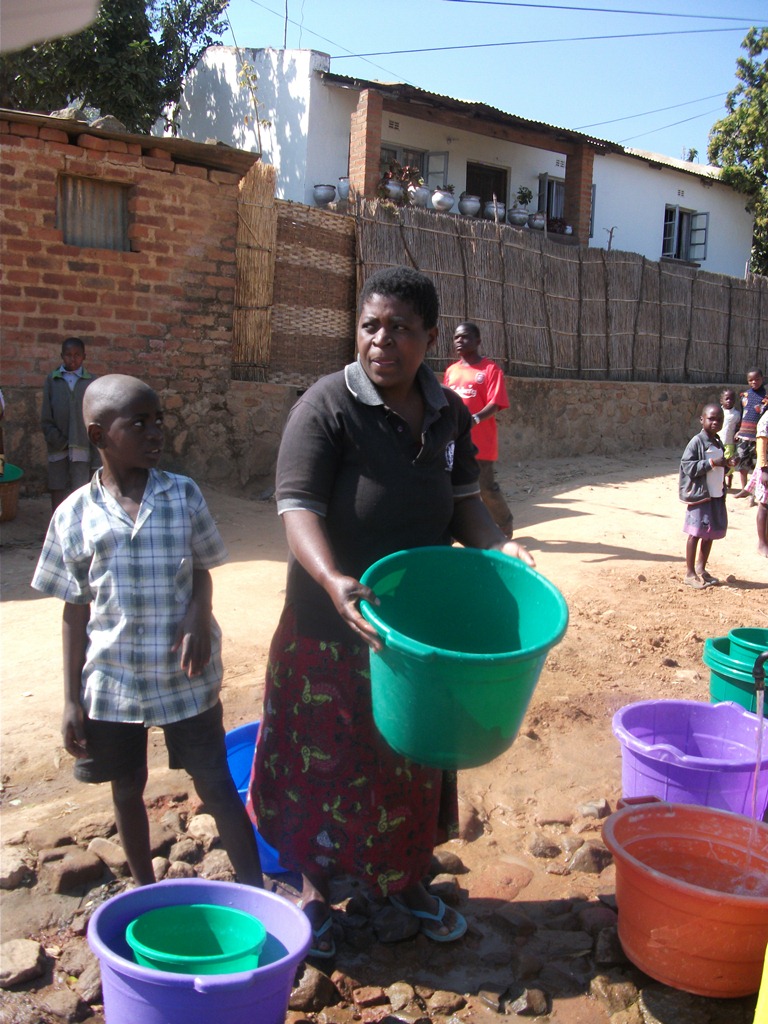
Woman draws water at Tchinga's kiosk
“We would go up there in the hills at night to draw water because during the day there would be many people and some would fight over who gets to draw water first,” said Fagesi Tchinga a longtime Chilobwe resident.
Blantyre Water Board has not even bothered to get its pipes near the area, maybe because most families there are generally poor or because the topology of the area is forbidding, we will never know. What we know is the people were caught between hard rocks and dry wells.
Joel Tchinga, husband to Fagesi Tchinga the woman who spoke earlier in this story, narrated the story of Nawotcha’s bad water days. He spoke from his house, which is one of the very last before Soche Hill becomes uninhabitable due to steepness.
The house is sandwiched in between huge rocks and right in his courtyard grows a Mubanga tree, a tree one would find in a real jungle and yet here 15 minutes from Chilobwe Centre it stands.
“It started as a political thing, Mr. Magwira and Mr. Chimombo wanted to be elected as councilors so they brought the idea of bringing water from up the hill, it was part of their campaign moves,” said Tchinga.
The two never got elected but their idea of harnessing water caught on among some people and so Tchinga and about eight other people invaded the hill.
Tchinga and Fagesi: Messiahs or Business People?
Each person of the eight lays his own pipes, each person has his ‘own’ spring, and each person has his own water kiosk where they sell water to the rest of the community.
Tchinga has two water selling points, one is watched by his son and the other has an employee. For anyone to tap 20 liters of water, they part with K15 and according to the family one tap turns over about K1000 per day. 
“I have two children in private schools, another is in college, I have put Iron sheets on my house and the rest greases the running of this household and if a senior loafer like me boasts of being alive, it’s because of this water,” said Joel, stroking his long grey goatee.
He has worked  as a watchman in several big companies since a living in Blantyre in 1980 from his home in Nchalo, he has lived in Blantyre long enough to own some land amongst the stones of upper Chilobwe where he has built some houses that he rents out. It is from this rent that he got the funding for his water project.
The water is tapped from natural spring about two and a half kilometers from his house this because he said he laid about 600 pipes each stretching four meters. He placed some cement around the spring and channeled the water into his pipes. No pumps, no damming.
The water comes straight to his house from where it goes to about 10 private customers and the rest goes to the selling points where women crowd around to fill their water canisters.
It’s not been an easy road for the Tchingas; many times than they can remember thieves have stolen their pipes that lie plastered on the hills. The family had to go into debt just to replace the stolen pipes.
“They stole my pipes so many times that I wanted to quit but I told myself not to not just because we find soap from the water but because we need the water, one night the water suddenly stopped i went up there with a weapon am not going to reveal here and missed one of the four vandals by the hair, since then my pipes have not been stolen again,” said Tchinga
Fagesi, the wife, said the coming of the water means little headache because the place she used to draw water from was far and that the water was not clean especially after the rains.
Confronted on the quality of water the family reticulates to the community, the Tchinga’s insist theirs is one of the best water flowing out of Blantyre taps because it comes from a hill that is not inhabited and is filtered by the rocks before going into the pipes.
The family said they have special days that they go to clean their water source but ruled out using water purification agents saying if they apply chemicals they go right down since there is no dam. The water source has also been covered [reportedly] so nothing can fall in.
We needed water: Tchinga

The hill is fast losing trees and just like the springs they used to draw water from, the existing springs are on their way to extinction if the rate of trees being felled continues; a thing that substantially scares Tchinga.
“The sustenance of the spring is at God’s mercy, he can dry it even tomorrow but as for the trees, it’s true that they are fast going and that the hill is drying since the trees provide shade to the water,” said Tchinga.
He said his and his fellow water providers formed a committee that tries to replenish and re-afforest ate the hill saying they plant up to 2000 seedlings per year but said it’s not enough since wanton felling of trees goes unchecked.
He said though there are guards to check tree felling, some community members go and fell trees at night and some go in the day and bribe the watchmen. Him and his fellow water providers do not have the legal mandate to patrol the hill or to stop anyone from felling trees since the hill is under the government.
“In the near future we want to be more aggressive in protecting the hill, we will decide how in our committee and take our proposition to the forestry department.”
Demand for the water goes down sharply when the rains touch down, households get their water from the many seasonal springs that pop up on the hill’s foot. Some trap water from their roofs but when October comes demand for Tchinga and Company’s water goes through the roof.
“People come this side from Chilobwe Centre especially when the Blantyre Water Board stops flowing, but the problem is that when October comes, our water pressure also drops after all my pipes are only two inches wide as you saw,” said Tchinga.
But a drop in water pressure is better than living in Zingwangwa in some adjoined houses with no pit latrine and yet with water flowing only from about 11pm. When water stops flowing in this part of Zingwangwa women remember their days in the village because they have to travel long distances trying to sniff for taps that are still running, in Bangwe, its worst.
Water is life
The latest Joint Monitoring Program Report by UNICEF and World Health Organization, states that 95 percent of people in urban areas and 80 percent in rural areas have access to safe water. This statistic is however contested by the charity Water for People - Malawi which says the de facto water situation in the 21 low-income areas of peri-urban Blantyre is that only 62 percent of people have access to water that meets government standards.
Blantyre Water Board will probably never bring their pipes to upper Nawotcha  and the natural spring is not likely to dry up in the next three years and during this period, people of Nawotcha  will not have water induced headaches but it all a time bomb and when the springs dry you will hear from Tchinga again.
Tchinga, Mazonda’s son, Chimera, Zaina, Mpazula and Chimombo are not names that one will hear during any awards ceremony in Malawi but what they are doing in Chilobwe -  that is using personal resources to bring water to hundreds of households -  is the type of action the dictionary calls heroic.