Wednesday, November 7, 2012

Fighting HIV one family at a time


Twenty seven years of HIV and the nation is still buckling under the weight of the pandemic, by December 31 fifty thousand fresh Malawians will have contracted HIV despite the various interventions that are being implemented…there is one intervention, however, that looks like it’s the panacea the nation has been waiting for.
The Kantuwanjes  -  enjoying their hakuna matata married life
 Jonas Kantuwanje, 44, teaches standard three at Mdeka Primary School, some thirty minutes outside Blantyre city, in his spare time he plays technician and fixes radios and televisions that people bring to him, as he works, his young wife Brenda, 22, potters about and the new-born baby in the house serves as an icing to the harmony.

Kantuwanje’s first marriage collapsed years ago and when he thought of remarrying his prime worry was HIV, back in his youth days the pandemic was not as menacing as it is today. He went on to marry Brenda anyway. 

Meanwhile Brenda was also wary of the same worry as her new man. For a man with two children coming to her, she could easily be an innocent victim of HIV.
“There was this silent tension in the house, each one of us silently worried and wondered if the other had HIV,” said Brenda.

Kantuwanje said that he knew that he could get tested at Mdeka Health Centre but the distance, and the fact that sometimes there were no test kits at the health center made him lazy.
Then came the light.
Dapp field officers counsel teens at Mdeka before testing them for HIV.JPG

From the blue, the group village headman, GVH Kabano called a meeting and announced that there would be HIV testers and counselors going round the village to provide what both Brenda and Jonas secretly wanted.

“They came to our house, counseled us and told us of the benefits of knowing our HIV status. We agreed and we were tested. It was a big relief to finally clear the mist between us. You see, after I knew that I was HIV negative I would never dare go out to another woman, I want to keep my status the same so I can say the testing made me responsible,” said the husband.

The wife also beamed and says that the two now live happily because there are no doubts. Well, no wonder a child soon appeared in the family.

The people that tested the Kantuwanjes were field officers from DAPP. Yes you read that correct, DAPP. It stands Development Aid from People to People and not sellers of second hand clothes. Of course, they do sell second-hand clothes but they do many other things too.

The programme that saw the Kantuwanje’s get tested in their backyard is called Total Control of the Epidemic. It is bankrolled by the National Aids Commission (NAC) and the United states Department of Agriculture. 

The field officers go door to door registering people, mobilizing each individual to an individual decision on HIV prevention and ultimately an HIV test.

Madalitso Chimtengo is one of the fifty field officers that DAPP employed for the door to door HIV testing and counseling exercise. He was assigned to test 4000 people in several villages in traditional Authority Chigalu’s area which occurs in Blantyre North. He gallops from one village top another on his mountain bike.

Chimtengo starts by noting that since the programme started three years ago, there is a visible behavioural change as those that have been tested are now responsibly living.  Already out of the about 3600 he has tested only just above 50 have HIV.

I asked him how he manages to beat the strongly held fears about HIV testing and go on to test people in their homes.

“Well, firstly, chiefs rallied the people and told them that we would be going around and again we do not go with the message of testing, we go and ask the people what they know about HIV, if they know little we tell them what they don’t know and then we tell them the benefits of getting tested.

“There is little rejection; the response was actually overwhelming such that it is the HIV test kits that ran out while people still wanted to get tested. If this was a country-wide programme HIV would be contained quickly,” said Chimtengo.

Already at Mdeka Primary School where some field officers had set up a testing booth, children as young as 8 years had to be chased off the queue of those wanting to get tested, its like testing is the new cool thing.
Asked if testing people in the villages is not going to fuel stigma, Chimtengo contests and reckons that it in fact normalizes knowing ones status and bolsters openness on HIV questions.

Chimtengo - There is Behaviour change.JPG
Chimtengo bemoans the lack of condoms in rural areas, the lack of test kits as some of the things that stand in the way of the programme. 

Florence Longwe coordinates the programme for DAPP and reckons that the approach works because of its personal nature.

The HIV and AIDs discussions are taken at a personal level and issues are not generalized. Hence individuals open up on what HIV and AIDS issues are directly affecting their lives.  In a mass media there is no personal dialogue where one can freely open up issues which are affecting them.

“TCE programme sees family as an important entry point for preventions, for stopping stigma and discrimination and rallying support for positive living for those on treatment. It is reaches out to people at their own convenient time and at the same time also those who find it difficult to go for such services due to transports or distance restrictions,” said Longwe.

She said the door to door makes it easy to reach men who usually do not go to clinics to get tested. Out of the tested in the TCE pogramme, 46 percent are men. 

 The project also has potential to reach more married couples who are the main culprits in the spread of HIV today, it difficult to find couple together unless they are at home. Again couples who are HIV negative or think they are because they don’t fall sick will never go to a hospital for HIV testing a gap that the TCE programme effectively fills.

And it is not just testing and counseling.

The project was phased out on October 31 but the Chimtengo said its effects will ring and stick around forever. Each field officer has trained volunteers in the villages who will take over the counseling in prevention, nutrition for the infected and the follow ups on all the rest.

For every HIV positive person, the field officers organised two family members who are supposed to check on the infected making sure that they faithfully adhere to their Anti Retro Viral drug dosage. Some members are trained in vegetable production while some were given heaps of shoes and the returns from the shoe sales are meant to economically help the infected. 

Gift Chitukula another field officer who also has tested over 3000 villagers proudly  declared  that he does not have more than 200 on his list that have HIV and this apparent low prevalence of HIV excited T/A Chigalu.

“I think the fact that we have been speaking and prioritizing HIV and testing has made people start to actually listen and change their behavior, already some bad cultural practices that fueled HIV have been eliminated, we have even banned overnight Kitchen top-ups which were new platforms of immorality,” said Chigalu.

Dapp field officers counsel teens at Mdeka before testing them for HIV.JPG
The programme is also being implemented in the low income areas of Blantyre and Thyolo. It was rolled out in 2007. There are about 25 field officers and each is supposed to test, counsel and follow up on 4000 people in three years. 

That is first to register and know them, then to counsel and or test then check of them later to make sure that those without the virus do not get it and that those with the virus do not spread it and are living healthily.

The Kantuwanjes can now enjoy peaceful sleep and as the Chimtengos and Chitukulas pack their utensils and leave T/A Chigalu’s area, the onus is on the community (over a million reached so far) to keep the sanity that the TCE programme brought.

Tuesday, November 6, 2012

Decentralising Justice: Phalombe Case Study


The twenty or so faces in the room are serious, the mood is tense. Judge George Kulangu sits facing Lonjezo Nkopeka, 14 who insists that he never impregnated Stella Chinkango, 18. Stella however actually tells the court the very date that she had sex with Lonjezo: 25 December and 2 January.

The defendant, fourteen year old Lonjezo is unmistakably his age: He has a baby face and it is only just starting to know adulthood pimples and acnes.

Stella and Lonje listen to 'Judge' Kulangu

He dons a cream shirt that used to be white and can no longer ignore the dust of Phalombe. Behind his shirt juts below his collar, Lonjezo has written ‘DJ. BY,’ not a strange thing for a recent Standard Eight drop out. He is in a jeans a piece of which he steps on as he walks in his flip-flops.

Right next to Lonjezo sits the complainant, Stella. She would pass for age 13 but guess the official story wins. She is clasping a cute and cuddly baby wrapped in several cloths despite the midday October heat. Her breasts are still firm and the baby has made them fuller.

After the facts of the case are presented, and Lonjezo asked to plead, he takes his kinsmen outside and returns to plead not responsible. 

Kulangu then reads from the constitution that according to the law, nobody can force an underage person to marry, he then reasoned with Lonjezo that the son he is turning down might end up as anybody and that he resembles him. 

Apparently touched, Lonjezo asks for another recess and comes back a different person, an elder relative who spoke on his behalf said Lonjezo would financially and materially support the baby but was unsure about the mother since he needs to go back to school.

Stella showed no expression. She was not impressed. She herself and her relatives took their own recess.
 As the trial progressed, the two try as much not to look at each other and instead focus their attention at Judge Kulanga who scribbles some notes as the two parties stated their arguments. Then his phone rings; he has an Orga Family ringtone, so much for a judge.

Well, George Kulangu, 35 is not a judge, he has never been to law school and the building he sits in is not a court. Kulangu is a volunteer, the building he sits in is actually an organisation termed Ufulu Wanthu Community-Based Organisation. (CBO)

The CBO sits at Chiringa in Traditional Authority Nazombe’s base about thirty minutes from Phalombe’s administrative centre. It was built by the community itself with support from Action Aid Malawi.

Kulangu is the director of the CBO and his team see an average of thirty cases per month. He does not get a salary and insists helping the community live in harmony makes him happy.

“We do not pass judgement here, we only counsel – we intend to build not divide people,” said Kulangu.
As Kulangu sits in his ‘court’ Chiringa’s real magistrate court is also hearing cases and it is just 35 meters from Ufulu Wathu. T/A Nazombe’s court is also a stone throw away and yet there seems to be no-one aggrieved or feeling underrated.

“They are helping us with cases, we had an influx of cases and we are working well together and I am not aggrieved because these people are easing my burden,” said T/A Nazombe.

Nazombe also conceded that it is only fair because as chiefs they demand some token to hear cases while at the CBO the cases are heard free of charge.

Ellen Mbulaje who mans the Victim Support Unit Desk at Chiringa Police Unit also hailed the CBO’s efforts and said she sometimes actually refers cases from the police to the CBO. She says since the arrival of the CBO cases of domestic violence have gone down.

One woman to attest to Mbulaje’s assertion is Adalina Tambwali, she told Nation on Sunday that her husband was irresponsible abusive and usually battered her and in some cases would have used knives, mortars to harm her over domestic issues.

“I chased him and he went to Ufulu Wathu to protest, I came and we resolved our issues and after the counselling he changed his behaviour and we are now living happily together, we just had our son. All along we had tried chiefs and elders but they failed to resolve our issues,” said Tambwali

A group of men and women Nation on Sunday talked to pointed at the advantages of going to their own creation (the CBO) by pointing out the weakness of the other justice systems in the community. They said Police demand money to offer bail, they said the court requires a fee to get summons and chiefs also demand tokens.

Ibrahim Nthalika is Action Aid’s programmes coordinator for Phalombe. He said his organisation takes a rights-based approach towards everything it does.

“We mostly work with CBOs, it’s the community that knows their problems well and therefore able to define their destiny and it is proving to be true.

 Ufulu Wathu CBO is working because people trust their own people unlike the civil servants at the court who are taken as elites and there is no imprisonment,” said Nthalika.

Nthalika’s expose explains why the community at Chiringa respect Kulangu and his mates. The CBO’s decision can easily be disregarded but the fact that the community itself created it to handle minor disputes confers salience at the organisation as a source of justice.

Stella came in from her time-out and told the seated that she had accepted the decision but was unsure that Lonjezo would follow through with his pledge. Kulangu asked Lonjezo twice and got verbal assurance. He said sometimes he makes the parties sign for their pledges.

If Lonjezo feels aggrieved, he can go to a real court; after all he went all the way to Phalombe District Hospital to prove that he is not the father of the baby, meanwhile he has categorically admitted that it was him that planted the seed in Stella after all.

The CBO falls under Action Aid’s broad theme of Human Rights and Good Governance, the NGO also supports other causes such as HIV/Aids, women’s rights, Rights to food and education.

Nthalika says the fact that the community took part in the setting up of the primary justice structure means that they own it and likely to sustain it even if the K5 million grants dried up, the CBO will keep grinding.
“We only provide finance and technical assistance, the rest is done by the community,” said Nthalika

Kulangu says most cases that come to his files are those of domestic violence and husbands neglecting their wives after harvesting. With the country struggling with domestic violence where women fail to report cases for fear of losing breadwinners to jail, structures like Ufulu Wathu might just be the panacea.

Kulangu and his team have been trained in proposal writing; paralegal services and only time will tell if what they have in their hands will mean a harmonious future.

As for Stella and Lonjezo and whether their early sexual debut is any hurdle to their future is a story for another day.

Wednesday, October 31, 2012

Travengelism: honest or sham?

Ever been in a bus that has no preacher shouting next to you, reminding you of the accident that can happen and the hell that awaits accident victim who were unrepented?

Well, in Malawi, almost every bus that leaves Blantyre to Lilongwe ir Mzuzu has such pastors, the guy in the picture is as this moment blaring with his husky voice preaching about Solomom's riches...but there are a few questions that I have for these guys,l.

Why do they only preach in Lilongwe bound buses? surely the people hoing to Thekerani need the gospel too, is it because they are generally poor?

Why do most of these guys mention accidents? is it to threaten the people?

Why do they ask  for moneys? most claim its transport moneys, but if they have no transport, why cant they just preach in their localities? do their neighbourhoods not need salvation?

My verdict is these people are just opportunists, feasting on our fear of dying and knowing that we are going to pass dangerous spots, they use fallacies to threaten people in more fear which then results into more moneys remitted.

They are the same with the African pastors who go establish churches in the UK saying the people there need deliverance when in the African villages they dont have branches of their churches...money is the root of most evangelism.

The guy in my bus just got a handfull of alms and is now dropping off saying 'may the lord gove back what you have given.'


Sunday, September 30, 2012

11 villages share a borehole in Ntchisi, Malawi


Rare sight in Ntchisi, a borehole at Kanyenda Village
“I can even say that about 500 people share a borehole here,” said Group Village Headman Kanyenda of Kanyenda Village in the southern part of Ntchisi District. 

He was outlining some development hurdles people of his area are facing during a meeting with the area's Member of Parliament. Water scarcity was top of his list.

In a later interview, Kanyenda stood by his claims and said that he has thirteen chiefs under him, that is almost thirteen villages and yet, he said, they all share one bore hole.

“We have Kakumba River as the nearest water source but it only has water during the rainy season,” said Kanyenda.
Chilapondwa: Problem is indeed big

Asked if he is aware of the development, MP for the area who is also Minister of Agriculture and Food Security, Ulemu Chilapondwa said he was aware of the problem and said he was trying to try to address the problem.

“Most of these boreholes were dug in 2007 under the Integrated Water Development Programme. Most of them are now defunct and most of them were shallow and thus dried up, I am looking at the issue to see what can be done,” said Chilapondwa.
GVH Kanyenda: We have a big water problem
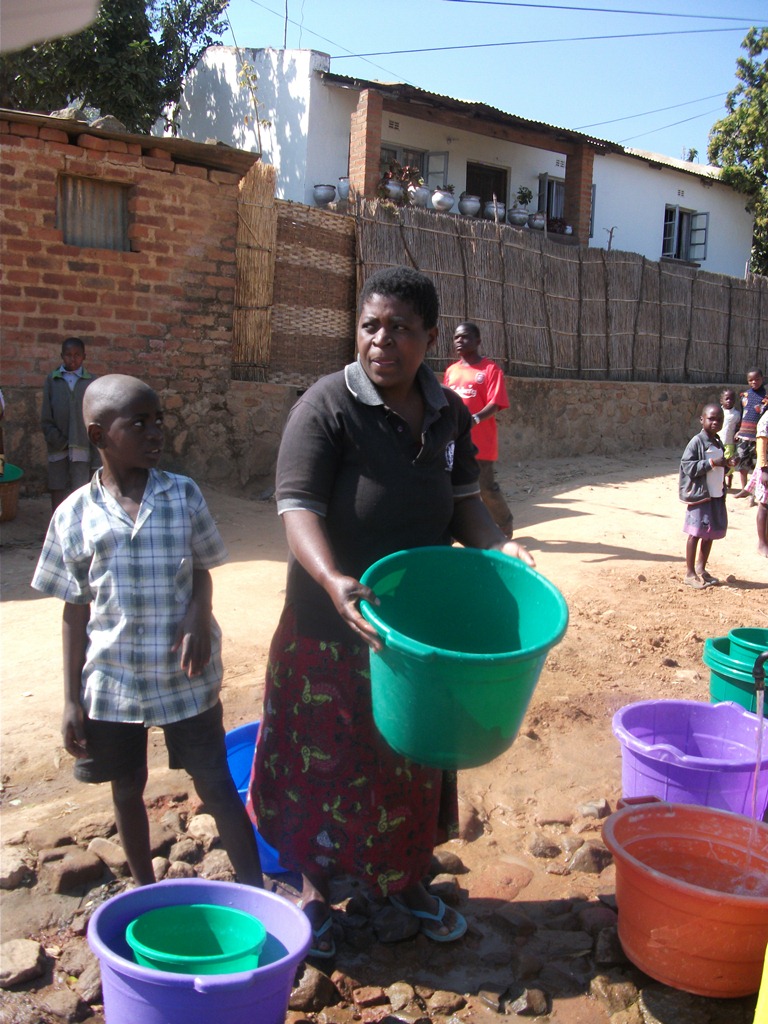
Standing from Kanyenda School and looking eastward, it is easy to see the water problem as the nearest borehole is crammed with about thirty women fighting to fill a bucket. 

The narrow paths leading into villages are also lined with women carrying colourful buckets of water and wandering in different directions.


Saturday, August 11, 2012

H2 All: The Equation of Life and Death


What does a community perched on a hillside with no water do? If your answer was “relocate” you would get half a mark because the real answer is ‘die.’ For the Nawotcha community, however, they chose never to die nor relocate and through some genius and altruistic moves of a few, everyone is happy and well watered.
The upper part of Nawotcha and Chilobwe in Blantyre has been without piped water since piped water begun, all along the communities had to rely on water that naturally occurs on the leeward side of Soche hill, the water was seasonal, murky and soon the boom in population mated with the decline in tree population along the hills saw the water drying up. 
To get water, one has to get further up the hill.
Woman draws water at Tchinga's kiosk
“We would go up there in the hills at night to draw water because during the day there would be many people and some would fight over who gets to draw water first,” said Fagesi Tchinga a longtime Chilobwe resident.
Blantyre Water Board has not even bothered to get its pipes near the area, maybe because most families there are generally poor or because the topology of the area is forbidding, we will never know. What we know is the people were caught between hard rocks and dry wells.
Joel Tchinga, husband to Fagesi Tchinga the woman who spoke earlier in this story, narrated the story of Nawotcha’s bad water days. He spoke from his house, which is one of the very last before Soche Hill becomes uninhabitable due to steepness.
The house is sandwiched in between huge rocks and right in his courtyard grows a Mubanga tree, a tree one would find in a real jungle and yet here 15 minutes from Chilobwe Centre it stands.
“It started as a political thing, Mr. Magwira and Mr. Chimombo wanted to be elected as councilors so they brought the idea of bringing water from up the hill, it was part of their campaign moves,” said Tchinga.
The two never got elected but their idea of harnessing water caught on among some people and so Tchinga and about eight other people invaded the hill.
Tchinga and Fagesi: Messiahs or Business People?
Each person of the eight lays his own pipes, each person has his ‘own’ spring, and each person has his own water kiosk where they sell water to the rest of the community.
Tchinga has two water selling points, one is watched by his son and the other has an employee. For anyone to tap 20 liters of water, they part with K15 and according to the family one tap turns over about K1000 per day. 
“I have two children in private schools, another is in college, I have put Iron sheets on my house and the rest greases the running of this household and if a senior loafer like me boasts of being alive, it’s because of this water,” said Joel, stroking his long grey goatee.
He has worked  as a watchman in several big companies since a living in Blantyre in 1980 from his home in Nchalo, he has lived in Blantyre long enough to own some land amongst the stones of upper Chilobwe where he has built some houses that he rents out. It is from this rent that he got the funding for his water project.
The water is tapped from natural spring about two and a half kilometers from his house this because he said he laid about 600 pipes each stretching four meters. He placed some cement around the spring and channeled the water into his pipes. No pumps, no damming.
The water comes straight to his house from where it goes to about 10 private customers and the rest goes to the selling points where women crowd around to fill their water canisters.
It’s not been an easy road for the Tchingas; many times than they can remember thieves have stolen their pipes that lie plastered on the hills. The family had to go into debt just to replace the stolen pipes.
“They stole my pipes so many times that I wanted to quit but I told myself not to not just because we find soap from the water but because we need the water, one night the water suddenly stopped i went up there with a weapon am not going to reveal here and missed one of the four vandals by the hair, since then my pipes have not been stolen again,” said Tchinga
Fagesi, the wife, said the coming of the water means little headache because the place she used to draw water from was far and that the water was not clean especially after the rains.
Confronted on the quality of water the family reticulates to the community, the Tchinga’s insist theirs is one of the best water flowing out of Blantyre taps because it comes from a hill that is not inhabited and is filtered by the rocks before going into the pipes.
The family said they have special days that they go to clean their water source but ruled out using water purification agents saying if they apply chemicals they go right down since there is no dam. The water source has also been covered [reportedly] so nothing can fall in.
We needed water: Tchinga

The hill is fast losing trees and just like the springs they used to draw water from, the existing springs are on their way to extinction if the rate of trees being felled continues; a thing that substantially scares Tchinga.
“The sustenance of the spring is at God’s mercy, he can dry it even tomorrow but as for the trees, it’s true that they are fast going and that the hill is drying since the trees provide shade to the water,” said Tchinga.
He said his and his fellow water providers formed a committee that tries to replenish and re-afforest ate the hill saying they plant up to 2000 seedlings per year but said it’s not enough since wanton felling of trees goes unchecked.
He said though there are guards to check tree felling, some community members go and fell trees at night and some go in the day and bribe the watchmen. Him and his fellow water providers do not have the legal mandate to patrol the hill or to stop anyone from felling trees since the hill is under the government.
“In the near future we want to be more aggressive in protecting the hill, we will decide how in our committee and take our proposition to the forestry department.”
Demand for the water goes down sharply when the rains touch down, households get their water from the many seasonal springs that pop up on the hill’s foot. Some trap water from their roofs but when October comes demand for Tchinga and Company’s water goes through the roof.
“People come this side from Chilobwe Centre especially when the Blantyre Water Board stops flowing, but the problem is that when October comes, our water pressure also drops after all my pipes are only two inches wide as you saw,” said Tchinga.
But a drop in water pressure is better than living in Zingwangwa in some adjoined houses with no pit latrine and yet with water flowing only from about 11pm. When water stops flowing in this part of Zingwangwa women remember their days in the village because they have to travel long distances trying to sniff for taps that are still running, in Bangwe, its worst.
Water is life
The latest Joint Monitoring Program Report by UNICEF and World Health Organization, states that 95 percent of people in urban areas and 80 percent in rural areas have access to safe water. This statistic is however contested by the charity Water for People - Malawi which says the de facto water situation in the 21 low-income areas of peri-urban Blantyre is that only 62 percent of people have access to water that meets government standards.
Blantyre Water Board will probably never bring their pipes to upper Nawotcha  and the natural spring is not likely to dry up in the next three years and during this period, people of Nawotcha  will not have water induced headaches but it all a time bomb and when the springs dry you will hear from Tchinga again.
Tchinga, Mazonda’s son, Chimera, Zaina, Mpazula and Chimombo are not names that one will hear during any awards ceremony in Malawi but what they are doing in Chilobwe -  that is using personal resources to bring water to hundreds of households -  is the type of action the dictionary calls heroic.


Friday, August 10, 2012

Maimed by crocs twice...but not ready to retire

 “The crocodile grabbed my foot. I grabbed on to the boat’s edge.  I was shouting for my dear life but my friends were all afraid and just hid in the boat while I battled the beast. I think they thought I was a goner and did not want to risk fighting fate.”
Like reading a picturesque novel passage, the scene that Simon Molesi, 35, of Nsamachi in Balaka, Malawi described was too unreal to really have occurred; but his left leg has no foot and stands like a pestle and on his right leg’s shin are marks of a crocodile’s grip.

There are few places in the world where people on bicycles can collide with hippos standing in the narrow mazy paths in maize fields. It is also very normal for a man to have no grave or a fake one because his body got eaten by a crocodile, welcome to the jungle.

On the northern  side of  Liwonde Barrage that sits on the River Shire is a small town that has come to being mainly because the no nonsense police  there demand that every person on a bus disembark so that they give  the vehicle and the luggage therein a good frisk.

Croc scar
The town lives on fish, big fish, fish most Malawians have never tasted let alone seen. Catfish, fish with mouths elongated like whistles, tilapia and some without English names.  

Even at 3am shadows of people in canoes can be spotted on the vast silent river. All sorts of fishing methods are used: nets; traps; hooks both on floats and with weights.
Shire is a provider for those living along it, but under the murky waters and mingling with the ship and sometimes in the overgrown bushes deathly danger lies, waiting to pounce on unsuspecting humans that get too comfortable in and near the waters.

Liwonde National Park is less than 10 Kilometers from Nsamachi and it’s full of Elephants, Hippos, Fish and Elephants.

Simon Molesi knows too well what to live side by side with wild animals means. He has escaped death by the whiskers twice – he has broken loose from two crocodile grips and still lives to tell the stories.
Molesi's legs or should i say leg?

“On January 1 2010 around 3am me and my five friends were fishing at Nkalawi just inside the national park. As a ring leader I would get into the water to make sure the net we cast was well placed, I had gone into the water twice and when I was about to get back into the boat on the third occasion, I felt a sudden pang  of pain…,” said Simon, a soft spoken father of two.
He knew he was about to die but the thought of his wife and children, the thought of disappointing his fishermen and setting a bad example to the upcoming generation of fishermen, he held on to the boat like a vice and if the crocodile wanted to pull him into the deep, it had to take the boat too

The tug of war between man and beast lasted not more than a minute as the crocodile yanked away half his foot and Simon quickly launched his body into the boat.

Simon narrated his story quietly and to the last detail; the exact time he was taken to the hospital, the exact date he was amputated at the ankle and discharged and how by November he was back to his fishing ways.

The rest of the Shire river has relatively low fish stocks due to overfishing, to get the real fish, one has to go into the national park, illegal but very profitable and at the place where Simon was attacked, one fishing round  can buy one a small car.

“Nkalawi is a dangerous place, I know of more than eight people that have died there, a guy named Charles from Silika village a guy called Kanong’a… even the park rangers fear the place, if you are there they will not follow you but wait for you to go further on or when you are coming back downstream,
Anything can be under the water

"There is plenty of fish there, you can hear fish making sounds on the water like rain, I remember we did one fishing job there and we got K106, 000. I went home with K17,000 the next day we made about K80 thousand and so on,” said Simon.

On the evening of the anniversary of the 2010 attack, Simon was back in the water and after getting in and out of the water without any scare, something happened, it was around 3am on January 1 2011.

“From the blue, a crocodile boomed out of the water and grabbed my right leg and again by the grace of God I yanked away my leg from his grip after a brief struggle,” said Simon.

He described a big crocodile that came out and got its fore legs into the boat trying to grab one of the 5 fishermen and nearly threatening to capsize the vessel. When the crocodile attacked Simon shouted for dear life and in terror but when he fell back and hid away from the beast silence reigned.

Again on this occasion Simon’s mates could not help him, they had fell flat on the boat’s surface as if there had been a bomb blast or lightning.

“We could hear it scrubbing at the boat at both ends at once and you can imagine how big it was, the boat was taking water and no one dared to cup out the water. Everyone was lying flat in the boat,” Simon said.
Liwonde Barrage

The crocodile gave up and by then one person had severed the anchor and the boat was drifting downstream but slowly, Simon said it took a good hour before someone dared to do anything in the boat.

“One of my friends got a bowl and started cupping out the water that was had accumulated in the boat, then someone asked me how badly injured I was and I showed them. My flesh was hanging about in strands and I was bleeding dangerously such that the night’s catch was floating in bloody water.”

Simon went to the hospital again and luckily his bone had not been severed. The doctor asked him to consider quitting fishing, but Simon says he is not retiring just yet.
“There is no other occupation I know out there apart from fishing, I never went to school and I have two kids an orphaned wife and I also have no father - just a mother who also needs my support,” said Simon.

Asked why he has not invested in anything yet, Simon said before the 2010 attack, he had been keeping some money but spent the whole lot during the period his amputated leg was healing. If not for the accident, he wanted to buy some land and erect houses to eventually rent out. He said he wants to leave something solid for the kids.

Simon is an expert fisher, it is why he gets the leading role when fishing but there is something else that he is popular for: Juju.

He claims that he can make crocodiles go away using his charms that he got from his father. He said surviving the crocodile attacks is partly because he is ‘protected.’

“My father gave me this medicine to ward off the beats, even the people around here know that  its why they trust and follow me to Nkalawi and so far no one has been attacked on my watch except me,” Simon says.
Fish in Liwonde is like snow in Greenland

Along the Shire River, people believe that some crocodiles are sent by their witchcraft practicing enemies and to guard this, Simon’s father travelled from Ulongwe just to help the son get ‘protected’ against both natural and man-made crocodiles.

He has a black bottle with grease-like substance, he has a small tea-bag like sachet and pieces of some tree bark and another tooth pick container that is sealed shut. He keeps the charms in dirty paper bag that he keeps somewhere in his bedroom.

“When we arrive at Nkalawi, I ask my fishermen to eat all their food, smoke if they are smokers then I pray to God for guidance and protection. Then one by one everyone has to take off their clothes and apply this paste which I dilute in water to their forehead, hands, belly and legs.

“Then I ask the crocodiles to leave and when I have to get into the water I get this (tea-bag like sachet) into my panties and while am out there I put a piece of this tree on all four corners of this house so that nobody harms my children and to protect us while we are out,” said Simon.

Looking at the way he described Nkalawi, where the probability of stepping on a crocodile when you jump into the after is almost one, Simon has all his faith in his charms. Surely there are few people out that can go into deep murky waters in a crocodile infested area and trust bag of roots to protect them.
Simon’s father died this year in a car accident. He was returning home to Ulongwe after visiting his son, Simon.
Magic gel
The father’s demise has left Simon in a fix: the father never told the son what trees he used to make the paste and the charms, when it would expire and where he can get more when it runs out.

Is this the end of Simon? Will he ever go to Nkalawi where one net cast can rope in a whooping K106,000?

“I know doctors, family and friends are still not believing why am still alive and would really not like me to go back to Nkalawi but look, I have my son Rafiki and my daughter Mervis and a wife who need to eat and I got rentals to pay. I am planning to go back to Nkalawi as illegal and risky as it is, I am trapped and the only way out is if some well-wisher can help me start a small business,” said Simon.
Sachet of life? The bag that goes into his panties to wave off crocs

With the medicine probably expired and no father to bring fresh supplies, having been attacked twice and when everyone has warned him against going back to Nkalawi a place where he knows more than 8 people have been killed by crocodile, it would be interesting to have a video feed of Simon’s feelings as he goes into the water and to see if he will come out to sell the catch.

The locals have a proverb that says it’s foolish to enter an elephant’s crotch twice; Simon has done more than thrice.