Saturday, August 11, 2012

H2 All: The Equation of Life and Death


What does a community perched on a hillside with no water do? If your answer was “relocate” you would get half a mark because the real answer is ‘die.’ For the Nawotcha community, however, they chose never to die nor relocate and through some genius and altruistic moves of a few, everyone is happy and well watered.
The upper part of Nawotcha and Chilobwe in Blantyre has been without piped water since piped water begun, all along the communities had to rely on water that naturally occurs on the leeward side of Soche hill, the water was seasonal, murky and soon the boom in population mated with the decline in tree population along the hills saw the water drying up. 
To get water, one has to get further up the hill.
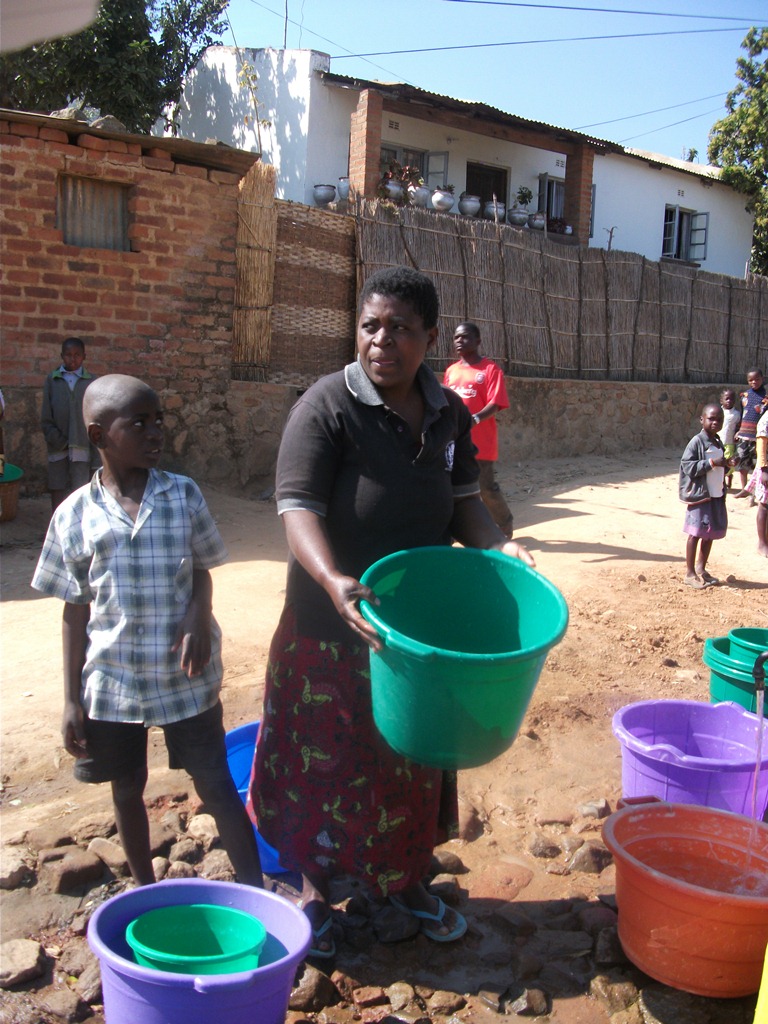
Woman draws water at Tchinga's kiosk
“We would go up there in the hills at night to draw water because during the day there would be many people and some would fight over who gets to draw water first,” said Fagesi Tchinga a longtime Chilobwe resident.
Blantyre Water Board has not even bothered to get its pipes near the area, maybe because most families there are generally poor or because the topology of the area is forbidding, we will never know. What we know is the people were caught between hard rocks and dry wells.
Joel Tchinga, husband to Fagesi Tchinga the woman who spoke earlier in this story, narrated the story of Nawotcha’s bad water days. He spoke from his house, which is one of the very last before Soche Hill becomes uninhabitable due to steepness.
The house is sandwiched in between huge rocks and right in his courtyard grows a Mubanga tree, a tree one would find in a real jungle and yet here 15 minutes from Chilobwe Centre it stands.
“It started as a political thing, Mr. Magwira and Mr. Chimombo wanted to be elected as councilors so they brought the idea of bringing water from up the hill, it was part of their campaign moves,” said Tchinga.
The two never got elected but their idea of harnessing water caught on among some people and so Tchinga and about eight other people invaded the hill.
Tchinga and Fagesi: Messiahs or Business People?
Each person of the eight lays his own pipes, each person has his ‘own’ spring, and each person has his own water kiosk where they sell water to the rest of the community.
Tchinga has two water selling points, one is watched by his son and the other has an employee. For anyone to tap 20 liters of water, they part with K15 and according to the family one tap turns over about K1000 per day. 
“I have two children in private schools, another is in college, I have put Iron sheets on my house and the rest greases the running of this household and if a senior loafer like me boasts of being alive, it’s because of this water,” said Joel, stroking his long grey goatee.
He has worked  as a watchman in several big companies since a living in Blantyre in 1980 from his home in Nchalo, he has lived in Blantyre long enough to own some land amongst the stones of upper Chilobwe where he has built some houses that he rents out. It is from this rent that he got the funding for his water project.
The water is tapped from natural spring about two and a half kilometers from his house this because he said he laid about 600 pipes each stretching four meters. He placed some cement around the spring and channeled the water into his pipes. No pumps, no damming.
The water comes straight to his house from where it goes to about 10 private customers and the rest goes to the selling points where women crowd around to fill their water canisters.
It’s not been an easy road for the Tchingas; many times than they can remember thieves have stolen their pipes that lie plastered on the hills. The family had to go into debt just to replace the stolen pipes.
“They stole my pipes so many times that I wanted to quit but I told myself not to not just because we find soap from the water but because we need the water, one night the water suddenly stopped i went up there with a weapon am not going to reveal here and missed one of the four vandals by the hair, since then my pipes have not been stolen again,” said Tchinga
Fagesi, the wife, said the coming of the water means little headache because the place she used to draw water from was far and that the water was not clean especially after the rains.
Confronted on the quality of water the family reticulates to the community, the Tchinga’s insist theirs is one of the best water flowing out of Blantyre taps because it comes from a hill that is not inhabited and is filtered by the rocks before going into the pipes.
The family said they have special days that they go to clean their water source but ruled out using water purification agents saying if they apply chemicals they go right down since there is no dam. The water source has also been covered [reportedly] so nothing can fall in.
We needed water: Tchinga

The hill is fast losing trees and just like the springs they used to draw water from, the existing springs are on their way to extinction if the rate of trees being felled continues; a thing that substantially scares Tchinga.
“The sustenance of the spring is at God’s mercy, he can dry it even tomorrow but as for the trees, it’s true that they are fast going and that the hill is drying since the trees provide shade to the water,” said Tchinga.
He said his and his fellow water providers formed a committee that tries to replenish and re-afforest ate the hill saying they plant up to 2000 seedlings per year but said it’s not enough since wanton felling of trees goes unchecked.
He said though there are guards to check tree felling, some community members go and fell trees at night and some go in the day and bribe the watchmen. Him and his fellow water providers do not have the legal mandate to patrol the hill or to stop anyone from felling trees since the hill is under the government.
“In the near future we want to be more aggressive in protecting the hill, we will decide how in our committee and take our proposition to the forestry department.”
Demand for the water goes down sharply when the rains touch down, households get their water from the many seasonal springs that pop up on the hill’s foot. Some trap water from their roofs but when October comes demand for Tchinga and Company’s water goes through the roof.
“People come this side from Chilobwe Centre especially when the Blantyre Water Board stops flowing, but the problem is that when October comes, our water pressure also drops after all my pipes are only two inches wide as you saw,” said Tchinga.
But a drop in water pressure is better than living in Zingwangwa in some adjoined houses with no pit latrine and yet with water flowing only from about 11pm. When water stops flowing in this part of Zingwangwa women remember their days in the village because they have to travel long distances trying to sniff for taps that are still running, in Bangwe, its worst.
Water is life
The latest Joint Monitoring Program Report by UNICEF and World Health Organization, states that 95 percent of people in urban areas and 80 percent in rural areas have access to safe water. This statistic is however contested by the charity Water for People - Malawi which says the de facto water situation in the 21 low-income areas of peri-urban Blantyre is that only 62 percent of people have access to water that meets government standards.
Blantyre Water Board will probably never bring their pipes to upper Nawotcha  and the natural spring is not likely to dry up in the next three years and during this period, people of Nawotcha  will not have water induced headaches but it all a time bomb and when the springs dry you will hear from Tchinga again.
Tchinga, Mazonda’s son, Chimera, Zaina, Mpazula and Chimombo are not names that one will hear during any awards ceremony in Malawi but what they are doing in Chilobwe -  that is using personal resources to bring water to hundreds of households -  is the type of action the dictionary calls heroic.


Friday, August 10, 2012

Maimed by crocs twice...but not ready to retire

 “The crocodile grabbed my foot. I grabbed on to the boat’s edge.  I was shouting for my dear life but my friends were all afraid and just hid in the boat while I battled the beast. I think they thought I was a goner and did not want to risk fighting fate.”
Like reading a picturesque novel passage, the scene that Simon Molesi, 35, of Nsamachi in Balaka, Malawi described was too unreal to really have occurred; but his left leg has no foot and stands like a pestle and on his right leg’s shin are marks of a crocodile’s grip.

There are few places in the world where people on bicycles can collide with hippos standing in the narrow mazy paths in maize fields. It is also very normal for a man to have no grave or a fake one because his body got eaten by a crocodile, welcome to the jungle.

On the northern  side of  Liwonde Barrage that sits on the River Shire is a small town that has come to being mainly because the no nonsense police  there demand that every person on a bus disembark so that they give  the vehicle and the luggage therein a good frisk.

Croc scar
The town lives on fish, big fish, fish most Malawians have never tasted let alone seen. Catfish, fish with mouths elongated like whistles, tilapia and some without English names.  

Even at 3am shadows of people in canoes can be spotted on the vast silent river. All sorts of fishing methods are used: nets; traps; hooks both on floats and with weights.
Shire is a provider for those living along it, but under the murky waters and mingling with the ship and sometimes in the overgrown bushes deathly danger lies, waiting to pounce on unsuspecting humans that get too comfortable in and near the waters.

Liwonde National Park is less than 10 Kilometers from Nsamachi and it’s full of Elephants, Hippos, Fish and Elephants.

Simon Molesi knows too well what to live side by side with wild animals means. He has escaped death by the whiskers twice – he has broken loose from two crocodile grips and still lives to tell the stories.
Molesi's legs or should i say leg?

“On January 1 2010 around 3am me and my five friends were fishing at Nkalawi just inside the national park. As a ring leader I would get into the water to make sure the net we cast was well placed, I had gone into the water twice and when I was about to get back into the boat on the third occasion, I felt a sudden pang  of pain…,” said Simon, a soft spoken father of two.
He knew he was about to die but the thought of his wife and children, the thought of disappointing his fishermen and setting a bad example to the upcoming generation of fishermen, he held on to the boat like a vice and if the crocodile wanted to pull him into the deep, it had to take the boat too

The tug of war between man and beast lasted not more than a minute as the crocodile yanked away half his foot and Simon quickly launched his body into the boat.

Simon narrated his story quietly and to the last detail; the exact time he was taken to the hospital, the exact date he was amputated at the ankle and discharged and how by November he was back to his fishing ways.

The rest of the Shire river has relatively low fish stocks due to overfishing, to get the real fish, one has to go into the national park, illegal but very profitable and at the place where Simon was attacked, one fishing round  can buy one a small car.

“Nkalawi is a dangerous place, I know of more than eight people that have died there, a guy named Charles from Silika village a guy called Kanong’a… even the park rangers fear the place, if you are there they will not follow you but wait for you to go further on or when you are coming back downstream,
Anything can be under the water

"There is plenty of fish there, you can hear fish making sounds on the water like rain, I remember we did one fishing job there and we got K106, 000. I went home with K17,000 the next day we made about K80 thousand and so on,” said Simon.

On the evening of the anniversary of the 2010 attack, Simon was back in the water and after getting in and out of the water without any scare, something happened, it was around 3am on January 1 2011.

“From the blue, a crocodile boomed out of the water and grabbed my right leg and again by the grace of God I yanked away my leg from his grip after a brief struggle,” said Simon.

He described a big crocodile that came out and got its fore legs into the boat trying to grab one of the 5 fishermen and nearly threatening to capsize the vessel. When the crocodile attacked Simon shouted for dear life and in terror but when he fell back and hid away from the beast silence reigned.

Again on this occasion Simon’s mates could not help him, they had fell flat on the boat’s surface as if there had been a bomb blast or lightning.

“We could hear it scrubbing at the boat at both ends at once and you can imagine how big it was, the boat was taking water and no one dared to cup out the water. Everyone was lying flat in the boat,” Simon said.
Liwonde Barrage

The crocodile gave up and by then one person had severed the anchor and the boat was drifting downstream but slowly, Simon said it took a good hour before someone dared to do anything in the boat.

“One of my friends got a bowl and started cupping out the water that was had accumulated in the boat, then someone asked me how badly injured I was and I showed them. My flesh was hanging about in strands and I was bleeding dangerously such that the night’s catch was floating in bloody water.”

Simon went to the hospital again and luckily his bone had not been severed. The doctor asked him to consider quitting fishing, but Simon says he is not retiring just yet.
“There is no other occupation I know out there apart from fishing, I never went to school and I have two kids an orphaned wife and I also have no father - just a mother who also needs my support,” said Simon.

Asked why he has not invested in anything yet, Simon said before the 2010 attack, he had been keeping some money but spent the whole lot during the period his amputated leg was healing. If not for the accident, he wanted to buy some land and erect houses to eventually rent out. He said he wants to leave something solid for the kids.

Simon is an expert fisher, it is why he gets the leading role when fishing but there is something else that he is popular for: Juju.

He claims that he can make crocodiles go away using his charms that he got from his father. He said surviving the crocodile attacks is partly because he is ‘protected.’

“My father gave me this medicine to ward off the beats, even the people around here know that  its why they trust and follow me to Nkalawi and so far no one has been attacked on my watch except me,” Simon says.
Fish in Liwonde is like snow in Greenland

Along the Shire River, people believe that some crocodiles are sent by their witchcraft practicing enemies and to guard this, Simon’s father travelled from Ulongwe just to help the son get ‘protected’ against both natural and man-made crocodiles.

He has a black bottle with grease-like substance, he has a small tea-bag like sachet and pieces of some tree bark and another tooth pick container that is sealed shut. He keeps the charms in dirty paper bag that he keeps somewhere in his bedroom.

“When we arrive at Nkalawi, I ask my fishermen to eat all their food, smoke if they are smokers then I pray to God for guidance and protection. Then one by one everyone has to take off their clothes and apply this paste which I dilute in water to their forehead, hands, belly and legs.

“Then I ask the crocodiles to leave and when I have to get into the water I get this (tea-bag like sachet) into my panties and while am out there I put a piece of this tree on all four corners of this house so that nobody harms my children and to protect us while we are out,” said Simon.

Looking at the way he described Nkalawi, where the probability of stepping on a crocodile when you jump into the after is almost one, Simon has all his faith in his charms. Surely there are few people out that can go into deep murky waters in a crocodile infested area and trust bag of roots to protect them.
Simon’s father died this year in a car accident. He was returning home to Ulongwe after visiting his son, Simon.
Magic gel
The father’s demise has left Simon in a fix: the father never told the son what trees he used to make the paste and the charms, when it would expire and where he can get more when it runs out.

Is this the end of Simon? Will he ever go to Nkalawi where one net cast can rope in a whooping K106,000?

“I know doctors, family and friends are still not believing why am still alive and would really not like me to go back to Nkalawi but look, I have my son Rafiki and my daughter Mervis and a wife who need to eat and I got rentals to pay. I am planning to go back to Nkalawi as illegal and risky as it is, I am trapped and the only way out is if some well-wisher can help me start a small business,” said Simon.
Sachet of life? The bag that goes into his panties to wave off crocs

With the medicine probably expired and no father to bring fresh supplies, having been attacked twice and when everyone has warned him against going back to Nkalawi a place where he knows more than 8 people have been killed by crocodile, it would be interesting to have a video feed of Simon’s feelings as he goes into the water and to see if he will come out to sell the catch.

The locals have a proverb that says it’s foolish to enter an elephant’s crotch twice; Simon has done more than thrice.

Friday, July 6, 2012

The Carbon Trade Comes to Malawi: What it means for the layman


It’s unprecedented: Malawi is now officially trading in carbon - an arrangement in which big polluters in the developed world are said to be reducing their emissions by funding projects that benefit poor nations who despite polluting less, bear the blunt of the developed countries’ pollution.

The Malawigovernment has just given an approval letter to CarbonSoft Corporation a London based carbon credit aggregator to start distributing solar lamps in Malawi’s rural and unelectrified households.

  “This [distribution of lamps] will enable them to stop burning kerosene, a highly potent greenhouse gas, for light, preventing CO2 emissions. CarbonSoft estimates that over the course of the six-year project, approximately forty-nine thousand tonnes of CO2 will be saved in this way, generating one carbon credit per tonne,” said CarbonSoft in a release published on prweb.com.

The solar light program is at the leading edge of a worldwide movement to reduce the burning of kerosene, key to the objectives of the Rio +20 conference on Sustainable Development, and the International Year of Sustainable Energy For All in 2012.

Shamiso Najira, Chief Environmental Officer and Focal Point for Clean Development Mechanism of the Environmental Affairs Department in the ministry environment and climate change said the approval was only given upon the Malawi government liking the project concept of CarbonSoft.

She said the role of the government will be to promote the project and said it would cover the whole country, a move which effectively means that CarbonSoft is aiming at eliminating Kerosene lamps in Malawi.

CarbonSoft is a carbon credits aggregator, it funds such projects and sells what ‘carbon credits’ a form of currency. The Collins English Dictionary defines a carbon credit as “a certificate showing that a government or company has paid to have a certain amount of carbon dioxide removed from the environment.” What this means however is that that company or government that has bought the credits maintains their pollution and uses the carbon credits to justify it.

Some people argue that the whole carbon trading  idea only allows rich nations to pollute more and not decrease their emissions because they  hide under the veil of buying carbon credits which are moneys given to a broker who is reducing carbon emissions elsewhere.

One critic of carbon trading writing in Time Magazine took a swipe at the practice saying: “In other words, the rich reduce their carbon output by not one ounce. But drawing on the hundreds of millions of net worth in the Kodak Theatre, they pull out lunch money to buy ecological indulgences.”

“The Clean Development Mechanism (CDM) has been a failure under any metric you look at,” said Oscar Reyes, Associate Fellow, of the Institute for Policy Studies speaking at a press conference arranged by the forestry policy NGO FERN at the UN climate talks in Bonn
Said Reyes: “Its credit price is lower than a snake’s belly and its environmental integrity is about the same – there’s little proof it has produced real, actual, additional emission reductions...”

Will Farmers Like Ngwira really benefit from carbon trading

Shamiso Najira when asked if the project is enough to address the climate change effects was non-committal and said it depends on the ones understanding of the issue.

“It’s up to us as a country, if it contributes to our sustainable development it is fine,” said Najira

Even the civil society is not sure of the carbon trade, William Chadza, Executive Director of the Centre for Environmental Policy and Advocacy (CEPA) said the issue has two faces.

“On one hand it is a welcome as it will lead to increased access to sustainable energy; address the challenges of our narrow Energy Policy; provides opportunities for financial gains from carbon markets; and increases Malawi's efforts towards climate change mitigation.

“Conversely, there is growing evidence suggesting that most of the carbon trading related interventions have the west as the major beneficiary as these interventions will only lead to perpetuating greenhouse gas emissions.

“As more of these carbon trading related interventions get underway, the more levels of greenhouse gas emissions in the west remain the same. It is like providing permits to pollute. It promotes business as usual approach. In addition, recent figures on prices of carbon per tonne seem unattractive to warrant significant livelihood changes which the proponents seem to be portraying.” Said Chadza

Chadza said there is need to do a good cost-benefit analysis on the issue; meanwhile the rich nations will keep emitting carbon and using their huge profits to buy carbon credits.

It is the likes of Stanley Ngwira a teacher at Thunduti Secondary School at Uliwa in Karonga that will keep suffering.

Early this year rains took a break for almost three weeks when Ngwira’s maize needed it most, the result was almost no yield at all, Ngwira is putting his hopes on the salary he gets from his job as a teacher and even then, his year looks bleak and there are far more people like Ngwira many who do not have a salary.

For Ngwira, the solar lamp he is likely to receive from CarbonSoft will just be used at night but the gruesome effects of erratic weather likely to be the result of climate change may haunt him for a long time.

Wednesday, July 4, 2012

Just now he saw, now he doesnt


Doctors at Queen Elizabeth Central Hospital have come to a painful conclusion; his eyes have been pierced and hence useless. On Thursday, doctors removed the left eye and the other will be removed on Monday and that will Maida Fedson blind a thing he never prepared for.

It was a day like any other, Maida having been laid off by his employer, was running up and down to find another job. He had to since living alone in Mbayani requires a job to pay the bills. Maida was invited by a friend in Machinjiri who had a job opening.

Luck was not with Maida as the friend was not home and Maida started back home he got delayed in the way and by 7pm he was approaching Chirimba Bridge the luck was to slip further to the negative.

“I saw two men, I passed one and as I approached the other one the one I had passed grabbed me from behind and squashed my throat so that I shouldn’t shout, the other man then flung his machete which landed on my head and opened me up,” narrated Maida sitting his hospital bed surrounded by family, sympathisers and the whole ward was quite listening too and interjecting with gasps when Maida toughed on the graphic part of his story.

Maida said the other guy then sliced a knife across his face cutting across the eyes like the equator, slicing both his eyes open, even though the eyelid was down. By then he had found space to shout and he had alerted a guard who came rushing to the scene scaring the assailers away.  

Maida was left with pangs of pain, he does not understand why he was attacked because not of the attackers took anything material from him apart from his sight and subsequently and arguably his life...
“At that moment, I knew my lights had gone off, that would never see again,” said Maida.

The guard took him to Chirimba Police where the officers starting bullying him instead of helping him.
“They said I had been attacked while trying to sleep with another man’s wife, they said I had been thieving, they started interrogating me despite my pain they asked me to list all my friends which I did promptly.

“They sent me to the minibus stage with a police report and that’s all they did for me, I had to use my own money and thanks to the kindness of the minibus conductor I was escorted to Queens (QECH),” said Maida.

Maida - Now a Liability

Four days will have to pass before Maida’s relatives knew of the attack; it had to take fellow patients alerting them a thing that infuriated Lickson Mangani, the nephew who stormed Chirimba police to ask after the behaviour of the cops.

“No statement was taken from Maida, they mocked him, they didn’t care to take to the hospital, they gave him a police report but when I went there they all denied until I showed them the report they gave Maida,” said an angry Mangani.

  The police report a bloody copy of which Nation on Sunday has seen has a Chirimba Police stamp, signed by a Jinazale on the 18 of June.

However Blantyre Police Assistant Public Relations Officer, Lameck Yona Thembachako, when contacted said Chirimba police has no vehicle and thus would have done nothing. On the officers mocking Maida, he said the police must have had their reasons because they cannot mock someone seeking their help.
Thembachako explained that when people go to the hospital they should return to police to have their statements taken.

Mangani said the Chirimba police then told him that the investigations would be difficult because nothing was taken from Maida. 

“After they remove the other eye, we are thinking of sending him back to the village in Salima where his mother and brothers are,” said Mangani.

Mangani said, and it is also calculable, that Maida’s life will not be the same again and appealed for well-wishers to step in since Maida’s mother is unemployed. 

Maida is obviously a strong character he gave the interview just hours after an operation to remove his right eye. He takes pills unaided and speaks calmly and the fact that he knew that he would not see seconds after being attacked will make his transition into blindness less stressful.

 To Maida the saying “Now you see, now you don’t” is actually literary applicable to his story and what awaits him in Salima is a story for another day, but surely a single, energetic 24 year old youth has been stopped in his tracks by people who are probably reading this and saying, “that’s us…”

Saturday, June 30, 2012

The role of Chiefs in a democracy: Looking ahead to 2014


Chiefs have been dubbed as the most respected office in Malawi by some commentators, yet time and again the office has let down Malawians by partaking in partisan politics and being used by politicians.

Kamuzu Banda used the chiefs to spread his one party ideals Muluzi also used the chiefs to advanced his yellow ideals but the chief’s political prostitution hit hard during the Bingu wa Mutharika era where they were drafted in to defend controversial propositions some beyond the chiefs understanding.

The most recent gaffe the chiefs have dabbled in is when they unanimously echoed Mutharika anti-devaluation stance following the luncheons the men of the robe had with the late president. 

Chiefs are essential in implementing many programs at the grassroots level, with the upcoming 2014 election chiefs will be needed in civic education exercise, voter verification, helping to curb violence, just to mention but a few. 

With the chiefs dabbling in politics will they not negatively impact the process? What should happen to ensure that the chiefs serve their role professionally?  

Chancellor College’s Associate Professor, Mustafa Hussein says it’s difficult to bring democracy to an institution that is assumed undemocratically by way of heredity. He however emphasized the need for such an office to be democratic.

“Traditional Leadership is provided for in Malawi in the name of the Chiefs Act as such I feel chiefs should play a role in enhancing democracy by being accountable, avoiding corruption and avoiding political manipulation.”

Hussein called for a review of the Chiefs Act to include stipulations that Cleary speak about chiefs and their relationship with politicians and ways of enforcing procedures in case chiefs do not abide by the stipulations.
Dr Blessings Chinsinga who used to argue for chiefs has considerably reconsidered his stance and is now a big critic of the chiefs, in one of his writings Chinsinga says chiefs are a confusing office as they are listed as very corrupt and yet most trusted by Malawians.

Chinsinga says chiefs breach people’s trust In search of short term self-aggrandizement. He listed the chief’s support of Bakili Muluzi’s Third Term bid and Chiefs coming out in support of Peter Mutharika during the DPP rule. Chinsinga wonders how all chiefs in the country suddenly have one view on a matter.

He also trashed the defence the chiefs use saying they work with the government of the day saying that is an abuse of the term because everyone is entitles to work with the government of the day but that does not mean forfeiting constructive approaches to issues.

Chinsinga pointed out that the Chiefs Act empowers the Chief Political Officer to do away with chiefs he deems irrelevant a thing that traps the chiefs into self-censorship. 

Human rights activist, Billy Mayaya also called for a review of the Chiefs Act to repeal some things that are not in tandem with Malawi’s democracy and to bring in changes that enhance transparency, accountability, inclusiveness tolerance equity and equality

“Chiefs need to internalise values and principles of democracy in order to be at the forefront of a dynamic- not a static-institution that respects protects and fulfills the rights of all subjects irrespective of gender creed or political orientation,” said Mayaya.
For a chiefly perspective, Weekend Nation spoke to GVH Ngolowera from Kwa Golden, T/A Chikumbu in Mulanje. We asked the chief what should happen for them to avoid political manipulation.
“Yes, Chiefs are like parents, they should be impartial and should oversee everyone regardless of their political party. If chiefs are to be impartial, I think they should not be allowed to comment on political affairs or participate in political campaigns and instead just listen to all views spoken by politicians and subjects,” said Ngolowera.
GVH Ngolowera

Hussein echoed Ngolowera’s sentiments and added that chiefs should realize that their institution is one of the most respected and thus they should represent all interests of all by helping democracy flourish.
As 2014 comes around, chiefs will be the target of politicians looking to use the chief’s traditional popularity for electoral gains, chiefs will be looking to the various politicians, especially the highest bidder for a pay-off in exchange for a hand in selling the politicians to the people, until the Chiefs Act or some law comes in this is how things will be.