Tuesday, April 26, 2011

OUT BUYING RELISH

“It's your turn to go buy relish; the money is on the table next to the onion!” My sister barked from her room. She expected protest but it was just what I wanted- to escape the noise that she called music and my claustrophobic room.

It was time to pull the old rusty gate while avoiding the greasy handle. All the men in the houses in the compound pull and push it.  The women, the children and the strangers that drop in to waste our time or hawk their cheap Chinese goods, perched on dirty shoulders and pinned on old cartons, all pull and push it.

I would wonder what would make that grease on the handle. As for the men; the sweat, the oil from work, the pudenda they had been fumbling minutes before sneaking out or morsels after a meal of fish, potatoes or pork.

Anything could be in that grease on the rusty gate handle that I have to pull at when going to the market. Think of the younglings of the compound: wiping their behinds with hands when elders are not helping or looking, the mucus combed from noses and pasted on unlucky surfaces, gate handles included. Or it could be the mud or the greasy fresh mangoes they had been wasting.

The mothers: they could have been tending to the babies seconds before fumbling the gate handle or could be coming from the toilet fixing their pads to prevent menstrual-used-oil from leaking and the most noxious of all, the hair chemicals. 

The thought of a husband making love to a woman with repugnant hair is unsettling; it makes one envision a man in a gas mask on top of his wife making sure that he keeps his head away from the woman’s head.  No kissing and no whispering sweet nothings in the ear.

By this time I would be out of the rusty gate, past the cakey and crackly brick fence and would be strolling down the dust path towards the bridge. A look at the brick fence would raise questions in me- why did the build it? It is obvious that it can’t keep out thieves; I would then conclude that it was designed to keep out the neighbours’ kids especially at lunch time, nothing else.

I then would stroll on, down the path towards the bridge clasping the money and the same paper bag that I would have used to buy relish for the last two weeks before it is used to light the charcoal stove when there is a blackout. By this time the paper bag is really just paper, with only one handle functional and the colour bleached due to overuse and the washing it faces each time it unloads that day’s load from the market.

 My sister says we don’t have to enrich the paper bag sellers; strange logic, I nearly thought she had been reading about pollution. It would not be pollution though, because the neighbourhood survives on it, not one house has a rubbish pit.

That thought would remind me of the day my aunt ordered me to escort her on a drive, I was so happy to ride her car that she defended so much from our behinds. It was around six, I sat in the back of the car fantasizing about her driving to a park to teach me how to drive.

As I sat there seeing myself on the wheel, she slowed down on the culvert and lowered the window next to me and told me to throw out the big lump that was sitting next to me. I complied and watched how the bag rolled downhill; rupturing and revealing the disposable baby towels, onion and potato peels that it encased. 

I felt bad but then noticed that everyone was slowing down at the spot and everybody pulled something from somewhere and flung it sideways while continuing their drive or stroll. 

“The neighbourhood has no space for rubbish pits, here the filth will soon be washed away by the river,” she said while stepping on the gas. She must have seen my inquisitive face.

Even when I walk to the market I see the road littered with debris from houses, either the rain, wind or cars carry it away or the soil will burry it. It invokes the image of futuristic archaeologists digging and pouncing on a disposable diaper and say, “Eureka! There used to be a baby around here!”

I would then push aside the thought as I approach the small market before the bridge. I have never seen anyone buy from here; their everything is just too expensive. My sister told me that the market is made to milk moneys from lazy people who don’t go to buy relish in time, and when its dark and the main market is too far people have no choice but to pay double here.

I would then pass the miniature market with my eyes cast down; I wouldn’t manage to face the women behind the merchandise. They see my paper bag and they know I need relish and they probably hate me for passing them with the money. In their minds they are probably wishing me bad luck.

“May he fall off the bridge and break his knee,” they are probably mumbling, “why would one walk past such good vegetables, just to save five Kwacha?"

 My mind would then wander on as I cautiously win my way through the tattered paper bags that litter my way. With the evil women’s thoughts aboard my clear mind, I cautiously climb down the hill towards the bridge. 

The so called bridge is really just two logs running parallel across the river with sticks flung clumsily across the logs for people to step on, barely keeping them from sinking in as one would in quicksand. Under the two logs, a small stream meanders among the rocks.

The water is green as if there is a Chlorophyll factory upstream, but it is just the collection of urine from bogus and porous sewers, used oil, grease from washing bodies and fertilizer from the maize fields that line the stream. 

The smell is nearly pleasant at first, it hits you as cooking potatoes and then the real nastiness comes, revealing to the nose buds every smell in the smell: the urine, the oil, the rotting frogs and their unhatched dead eggs and the decaying branches that lie on the riverbed.

I would cut airflow to the lungs as I balanced my way on the two logs and step on the other side, then let in a big breathe of air to feed the empty lungs,  regrettably the gulp of air is also full of the detested smell. 

It must be something with my uptown nose because a look downstream shows women washing in the water, children somersaulting into it and some drawing it for home use. I would then visualize green rice made from it, what dish would that be? ‘Rice on the pollutants?’

Soon after the bridge I would be ready to enter the market, but not before passing the refuse dump at the market gate where shabby and shaggy members of society sift for what is good in what the rest have termed garbage.  Sugarcane, wood chips, metal bits and plates, torn sacks and rotten tomatoes. Why did they not sell the tomatoes at discount than to lose it to bacteria?

Different people ooze in and out of the market. Men holding hands, men in skirts and in women shoes, men looking like they have no shaving money, men that overdid the shaving with heads cleaner than buttocks, men with red eyes and men sucking on sugarcane. If there was a statistician at the gate, the mode would fall on men sucking on sugarcane.

There is something with sugarcane and folks from high density areas. The streets are lined and smeared with white cleanly chewed sugarcane remains and city officials seem not to have problems with ridding the streets of the cane remains every morning.

It seems ghetto people know that they cannot afford the processed sugar and they see the fresh cane as the source of all their sugar, the only sweet thing they can afford. 

I would be past the sugarcane guzzlers and sellers near the gate and squeeze my way in the sea of people wandering up and down the market.

There is something about the women here that I find interesting every time I come for relish. No matter how beautiful they are they all have one serious issue to point out.

Talks of a beautiful girl, a beautiful face that it but with breasts hanging at the same level as her navel and she cannot even think of the word ‘bra.’  I spot another well dressed and pretty girl and then she smiles at you and walks straight to a stall where they sell mice and she buys about thirty and goes away...

Gangster looking faces smile and blush to the ladies in the market crowd making me think of replacing the police with these ladies. She can walk to a tough guy and ask him, “Do you have ganja on you?”  And if the gangster says yes then she calls in backup and asks again, “do you want to hear your rights?”

Talking of gangsters and ladies makes me imagine the intercourse that takes place in the neighbourhood. HIV faces and babies keep appearing indicating great activity after dark. My uncle once said overpopulation can be dealt by bringing electricity.

“Dinner is at six, at seven people are in bed, what do you think couples do in the dark? If they village and the ghettos had lights, people would be watching TV or listening to radios till they are too tired to make babies, simple logic,” boasted my uncle.

The market has everything one would need from salvation to damnation. There is a guy selling burnt bulbs here and another guy hawking old calendars, empty nonreturnable bottles and empty TV cases there.

Grasshoppers and small birds selling like hot cakes, used bent nails, video cassette tape rolls for people to decorate their weddings with and a stall with chicken heads only, a thousands of heads.

Stalls separated by two meters playing different music both at high volume, a seller shouting at his customer after he changed his mind after already paying for cooking oil in plastic phials.

There would be a charming preacher speaking of hope and riches that come to those who give. It’s funny how market preachers research so that when they shout the message is almost directed at you and you are so touched that you give some of your money in offerings in the dirty plates that aides circulate as the preacher prattles heavenly dogma.

“God saw what you did yesterday, he saw what you did to her, he heard what you said about him...if you know you have sinned raise up your arm and pray with me,” the preacher would say, attracting scores of people, most of whom did things the previous day.

 I would then shrug off the fantasies as I pass the boys with paraffin tubes on sticks on the corner and then suddenly a vast open space of relish sellers would face me.
“Makelele Crapao, cheap,” a Mackerel seller chants, “veges here, sire: these good with groundnuts and those with cooking oil,” another would say, “somba nyama apa!” another would chaunt and leave me wondering what kind of fish really tastes like meat.

I would then stand and realise that I hadn’t decided what to buy, leaving myself at the mercy of the coaxing and intimidating hawkers.

 I cannot buy the Mackerel because my sister claims she is allergic to them, not the cabbage because my brother says the sugar in it causes nausea when mixed with salt and the eggs are also out of bounds because they are for tea not dinner.

“Don’t pretend that you can’t hear because you can, go and buy relish before it gets dark and worse still before brother comes from work and finds no relish!” said my sister, still shouting and jostling me from my fantasy.

I pushed aside my novel, slipped my feet into my sister’s sandals and put the money into the tattered paper bag and closed the door behind me facing the gate handle, I carefully avoid it and I disappear towards the market.

Monday, April 25, 2011

BEDLAM ON QUIET STREET

The din was enough to wake the dead. I could hear it from five kilometres away on the lake. I suspected some kind of reception. The village is always busy doing nothing this time of year and the only thing that households know is beer parties and marriage send offs.

I banished the idea of a funeral from my head, nobody was sick in my village. Furthermore, the other inner me confronted me of being too pessimistic, so I continued fishing, feeling the sharp edges of the small wooden canoe piercing into my buttocks while I held steady on to the fishing line waiting to pull on the fish that dares it.
Fish are rare nowadays but on this day, they were unveiling themselves as if to compensate me for missing the commotion in my village, I had four slimy precious catfish and another was on its way up. It was a rare trout-type-of-fish, so rare it doesn’t have an English name. It refused to die by pulling on the line and threatening to straighten the hook and break free. 

As soon as I loaded the stubborn fish onto the canoe I looked back at my village smiling. My father said my growing up in town meant that I would never become a fisherman, well here I was...as I confronted my father in my mind and looked towards my village, something told me to hurry.
I paddled shoreward with all my might. I was sure of what I saw; there was a crowd at the village courtyard, which was also our lawn. Something was the matter and the shouts mingled with the wailing were certificates of certain trouble.
The beach was unusually quiet for four of the clock in the afternoon, it would usually be thronged with younglings dicing with the murky estuary waters and the elders would be tendering to their nets, patching the holes that debris delivered by the river made in their nets.

Not even the lazy ones were there to slant their heads, telling stories of how much flour they had and the only thing that has been keeping the children hungry was the scarcity of fish. Their absence, especially of the fish beggars, was very unsettling.

The beach was only empty when there was a derby football match between the village team and the one from across the river or when there was a political rally which meant free beer and meat for the lazy and the guzzlers, dance money for the ladies and chance for mischief and collection of empty bottles and bottletops for the kids.

I panicked; I rushed to the near bushes where I had hid my clothes from belt and slippers thieves that lurk the beach. I then pulled at the canoe to keep it away from the water as possible, this by lifting one end of a canoe and staggering in a half circle towards land then going to do the same to the other end until the canoe was about three meters away from the water.

I took the wooden paddle drove it into the fish from the gills to the mouth so that the fish hang like clothing when the paddle was balanced on my shoulder. Everybody would give respect to someone with such a catch, especially the women picking cassava leaves for relish in the fields. Others would offer cash and others would use their in-law and chief status to extort the fish. Today there was no one to admire or take away.

I rushed through the thick shrubbery and the piercing reeds that emitted lake flies when disturbed and to add the pressure to my panic, the quails that suddenly flew from two meters leaving you panting with fear. Why do these birds not fly until you are this near? No wonder the Israelites picked them for manna.

Running in the sand is useless and annoying when you have distance to cover, the road back to the village is as sandy as the beach and it takes crisis to notice the annoying sands. Children love the hot sand; walking five meters then jumping on grass to cool off. I had slippers on and didn’t worry of heat after all it was nearly sunset.

The only itch was the slippers sinking into the sand behind me then launching the sand onto my bare back and then the sand gliding down my back with some bits finding their way into my panties where they created all kinds of discomfort. With the village up ahead, and the din growing louder I cared less of sand balls sharing space with mine.

The first person I met on entering the village was the shabby village laughing stalk with an acute syndrome that left him glorifying food and nothing but food all day.

“Hey, what is going on?’  I asked nicely.

“Pasaku somba yooh,” was the answer the fool gave.

There was no one but I still did not curse the unhelpful man, I feared it would multiply my chances of finding something grave up ahead, which means in normal cases I would have cursed. Going beyond the prescribed diction of the dictionary was the way of the lakeshore after all, I would have said something about his drooling mouth or his funny head - instead, I ran on.

I was home. There was a ring of people blocking it thoroughly with the children outside the ring trying to peep through the elders’ hips. Inside the ring was my uncle or my young-father as we would call him, he was brandishing a machete and was being restrained from entering my fathers’ house by three other elders. 

“What is going on?” I shouted: I never trusted my uncle because he showed too much that he wanted my father’s chieftaincy. I always knew and feared that one day he would try to hasten the passing of my father to get the chieftaincy, since he was next in line.

“He has raped, this young one...yes Dorofy, he has hurt her bad and he is in there! Let me go and cut off his manhood why are you protecting him?” my uncle shouted and I know the last  statement was not directed to me, it was for his captors,  after all I was not there to listen.

Dorothy was my only sister, she was only twelve and after the passing of mother, she did all the motherly work at home. Who had raped such a young sweet innocent child?  Her breasts did not even have the power to push against her t-shirts and make any visual impact. 

I knew small boys that hung around the house trying to date her but they were too young to rape her and even if they did, the resultant sex would be fair. I knew it was somebody big and my father was hiding and shielding him in the house in his chiefly capacity. I calculated that this is what had animated and angered uncle, who always tried to earn marks by pouncing on and rectifying my father’s mistakes. 

I never answer back when my father addresses or undresses me. I have never rebelled, but today I would confront him to release the rapist. I was not going to hear his wise owlish statements today; nobody rapes my only sister and goes unharmed.

I was thinking about all this while I fumbled over paraphernalia in the pantry, the sacks, the mortars, the old pots, the panga, yes that was what I was looking for! I grabbed the machete and the crowd did as it had done before by splitting and giving me a good space as if I was the only one with a solution to the hullaballoo.

I felt an arm on my arm and when I jumped onto the veranda I heard someone falling behind me, I had overpowered him. The living room was empty, only my aunties were there, all crying.  When they saw me they cried harder and louder. I went into the corridor towards the rooms. All the rooms were wide open and empty and at the far end lay my fathers’ and the houses’ master bedroom.

It was locked but I was too angry for it and soon the door fell inwards, succumbing to my one kick, I stepped in with the machete in the air. There in front me and hanging from the roof, struggling, was my father dying.
I threw down the machete, my arms were weak. I then knew why his younger brother was so determined, why my aunties were raising their wailing voices when they saw me and finally why my father was committing suicide.  

I could have saved him by climbing on the bed and then using the machete to cut the string from which he was hanging, instead I went to the sitting room and told them to make space for the body and funeral.

Saturday, April 2, 2011

‘It sure feels like the 70’s Cambodia’

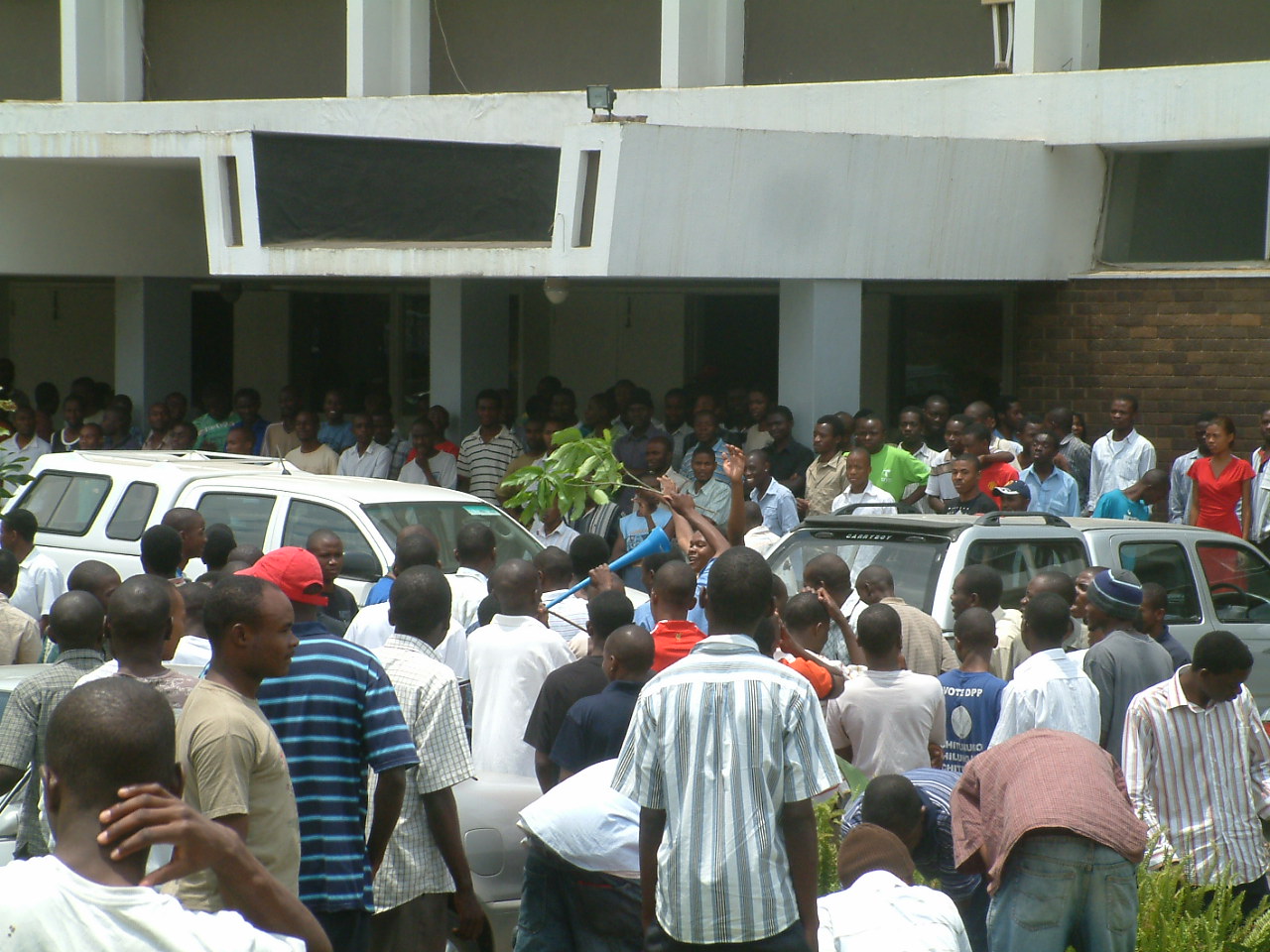
I released this press release after the University Council of the University of Malawi decided to close down the two main universities in Malawi...giving students two hours to vacate campus and they did so at gun-point. the PSU is the Polytechnic Students Union and  i am its spokesperson.

We the PSU feel that the decision to close down the university is not only morally, practically wrong but also illegal and illegitimate.

Poly Students were never in conflict with the University Council, actually we only knew of its existence after the ‘academic freedom’ battle began. To us, this fact tells us that the council lacks sufficient interest in the issue.

When lecturers downed their tools, the university council never sent them a bogus memo with typographical errors on fools’ day giving them notice of vacation. Why students? Is it because we have no legal muscle? We have been calling for dialogue on the issue but the warring sides refuse and chose to use us as pawns.
To add salt to the wound; take Lemmy who hails from Chitipa and he has two hours to pack and then find transport money to go to Chitipa, and its already 2pm. Is this decision made with ‘fairness’ in mind or it was just some sort of vendetta?

Polytechnic students chose to take a stand in the issue, as the adage says; fight for something or fall for everything, we analysed the academic freedom battle and found it sweet and worthy the ride so when Poly lecturers joined the battle by downing tools we never whined, we giggled with excitement. When the same lecturers dropped the battle we took it from where they left it.

Our argument was simple, learning these days is learner centred thus academic freedom is chiefly for the students.  Secondly, we saw bribes and cowardice in the lecturers’ decision to drop the issue, so we demanded an explanation and when we heard from PASCOW’s chair, Salima that it was due to tribal allegiances, we declared Poly a no fly zone for lecturers, anybody would. 2011 is no time to be dabbling in tribal foolishness and as lecturers they should know better. So the students; Lhomwe, Tumbuka, Chewa and Sena fought on.

We feel that the involvement of police in this issue is not legal. We are fighting with Mukitho and how do you expect the same Mukitho to handle us? It’s why we have police officers gassing students and beating us like bags of sand. 

Police involvement is also illegal in that the Kampala Declaration forbids any police presence on any campus or where African intellectuals are...why do Malawian police, led by the whole commissioner invade our campus? Yes we know most of them are brutes but at least they should have heard of the word ‘law.’
Now we have lost a student, Justice Mwafulirwa,  yes he had lung trouble but what sparked the final blow is cleary the gas that was settled on campus, there have been about five cases of students collapsing in the hostels since the teargas was fired, and they have been none since the semester started, draw your own conclusions.

We will not speak much on the minister of education here, because he has failed us miserably and if he thinks this is a lie, let him try to come to Poly one day.

Finally, we have our chancellor, forget the debate about the legality of his post as chancellor; to us he is the one to blame for all that has transpired in this conflict and to achieve peace will also demand his hands as well.
When the president was being inaugurated, he vowed never to close down any university in his reign...how ironic and funny does it feel to finally break the vow on fools’ day?
At first we thought the president would quickly apply Machiavellian philosophy and fire Mukitho to make peace with the whole load of critics, most of whom are influential, but to our shock Mukitho was glorified and the rest vilified effectively starting the ‘Chinsinga wars.’

The details are not our concern, but we are the sufferers, we know that as university students we have the power to start a revolution but that depends on the failure of government not on a single lecturer. The university system is too complex for anybody to manipulate.

The way forward depends on what the president will do and on the way the grieving lecturers will be handled. Already Poly students are swearing to continue where they left off if any lecturer or student is fired.
 As a union, and as we said at our previous press conference, the issue will only rest in our hearts if the law takes its course, we can’t be having anybody coming to campus and saying and doing  things in the name of national security especially when they have never been to a campus before.

We hope this is not the beginning of the Khmer Rouge type of government which hated intellectuals and eliminated most of them because of the ideas of a few. Already, we cannot seem to stage a demonstration without the City Assembly and police firmly refusing us permission.

 We also should take time to salute those who have stood firm in this time of battle, names like Kamchezera, Kapasula, Salima, Amin, Kanyongolo, Mungoshi, Sithole, Morra and Mgala.

PSU would also like to thank the public and the independent media for being understanding and empathetic even when we were being violent and barbaric. Desperate times call for desperate measures.

The law, through the constitution and the Kampala Declaration speaks of academic freedom, let government grant and assure it.

As PSU, we are disappointed in the system and we hope that when we return we shall find no spies in classes, no intimidated lecturers, no uniformed brutes on campus, and we hope that we will return to campus very soon as the world, including the police force, is waiting for our well trained input.

Monday, March 7, 2011

How to analyse an advert semiotically - case study of Zazoo condoms advert

Semiology is concerned with anything that can stand for something else or as Umberto Eco says “anything that can be used to lie.” Semiotic analysis looks for signs and what they stand for in media text and as van Zoonen argues, “Semiotic Analysis is a powerful tool to understand how sign system in mass media can evoke emotions, associations, fears, hopes, fantasises and acquiescence” (quoted in Taylor and Willis, 1999:26). This paper will thus attempt to semiotically analyse an advert for Zazoo condoms and come up with an academic review.

In the advert, (available at: http://www.youtube.com/watch?v=x-OqKWXirsU, attached) a boy and his guardian are on a shopping spree and the kid sees a pack of sweets that he finds irresistible. When the boy tries to smuggle the pack into the shopping cart his guardian refuses to buy it, the boy then causes an embarrassing scene forcing the guardian into buying the sweets.

The advert is not explicitly connected to condoms and it is why it makes a good text to semiotically analyse because most of the signifiers are connotatively linked to the signifieds in line with Taylor and Willis (1999) who assert that language, signs and their meaning are historically, culturally and socially produced.

The mood of the advert is normal, balmed by the slow music playing in the background, the lighting is also not manipulated in a big way, and then the trouble begins.

The first thing that can be spoken of a sign is the packet of sweets; its’ yellow colour serves to attract customers and to stand out, that is on a marketing side...a close look at the colour yellow will point to something that is promising, sweet, warm and exciting things. Some robot signs use yellow to indicate “go.” (http://www.elizabethan-era.org.uk/color-yellow.htm)

Yellow attracts the youth who are adventurous and ready to go for promising things; here is where teenage sex can be brought in. The youth are anxious to experiment with sex especially with puberty and peer talk that tends to make sex a must have.

The boy’s guardian in the advert stand for society in real life, it has rules laid out for youths, but just like in real life, the youth will not just listen.

The boy, who by now represents the youth, adopts a way to coax his father into buying the sweets for him; he burst into a loud crying session and makes a scene to embarrass the father.

The boy’s actions can be said to signify or represent what the youths of today’s society do, if society doesn’t want them to socialize or have sex freely, they will make a scene and do something bad such as getting pregnant or catching some disease.

The father tries to hush the boy as society labours to suppress the youth but they don’t usually listen and the dad bows to the kids demands and buys the pack of sweets. The message is the same, society doesn’t endorse premarital or extra-marital sex but since the youth seem too determined to have it, it is better to let them use condoms to avoid the negatives of unprotected sex.

The producer of this advert or text has used several tactics to carry across his or her message to readers as Alexander Clare argues “analysis of all of the adverts will strongly focus upon the advertisements' photographic imagery, and the ways in which this imagery generates the appropriate signified concepts (or emotional overtones) which promote the image of the product.”(Chandler, 1997)

Camera shots have been manipulated and the manipulation itself is a sign. The biggest close up shot in the advert is shot where the kid is at his angriest, like in the Chinese Kung Fu movies, Extreme close ups are used to show the anger or anguish on the faces of actors...it can thus be said that the mere fact of using an extreme close up signifies anger.

The anger described above will make the readers of the text to side with the child and once this happens the producer will have begun achieving his goal of selling the condoms although the audience does not yet know this fact.

The capitalized subtitles “I WANT THOSE SWEETIES” are also worth exploring in the text. In the world over whenever one writes in upper case, they are either angry or illiterate and because it is obvious that the producers of this text cannot come up with such an intelligent ad and still be illiterate they are probably trying to show the kids anger.

Gestures and expressions of the cast in the advert are also sign that can be of importance in talking about the text, semiotically. The gestures represent what Saussure termed codes or the language sign users use. (Taylor and Willis, 1999)

Saussure asserted that languages and their codes are constructed the paradigmatic and syntagmatic axial dimensions and that while some signs serve to scaffold a point some pull the meaning/ expectation in the opposite direction(Taylor and Willis, 1999:21)

The father puts a finger to his lips (as if to say “keep quiet”), puffs out air (to show resignation), avoids eye contact from other shoppers by casting his glance on the floor(to show embarrassment) and shrugs(again, resigning).

The boy, after smuggling the candy pack into the cart, ties his arms across the chest and gazes unblinkingly (to challenge his superior), shouts his cries despite his interlocutor being about a metre away, throws items from the shelf and lies on his back and cycles the air using his legs.

While the audience paradigmatically sides with the boy, the message “use condoms” at the end of the advert syntagmatically shatters the sympathy and throws the reader into some kind of dissonance which may or may not be balanced by accepting condom usage.

The other shoppers represent the critics in society. They ignore the child’s deliquence and focus their gazes on the parent. Their gaze is a sign signifying disappointment and disapproval.

The advert ends with a still shot of a red packet of condoms with the inscriptions “one for 2.” The portrayal of the box is as pregnant with signs as the squealing child.

The red carton speaks of the importance of the box’s contents especially after the bad things that can happen to those ignoring have already been beamed.

The phrase “one for 2” stands or signifies what is contained in the carton and it is not easy to know that it mean that the box has two usable condoms.

The whole packet and message stands for the real product in a shop somewhere and the portrayal stands to instil the image of the real products in the viewer or reader of the text. The bigger picture, however, is that the packet is the solution to the problems of child bearing (as denotatively shown by the ad) and solution to the unabstaining and passion seeking minds.

It has already been asserted that signs are contextual and as Taylor and Willis (1999) put it, signs are also polysemic that is they have the potential to be interpreted variously by different readers. The advert can thus be seen from another perspective as well.

The advert was aired at a time (2004) when global condom usage among youths was slumping; the advert can thus be seen as a warning to careless couples of what awaits them. (http://answers.yahoo.com/question/index?qid=20101003221541AAN513q)

The looks on the faces of the other customers in the mall are an indication of the disapproval that awaits the rashly parent.

The discussion has, in a nutshell, picked out the semiotic signs in the Zazoo advert and expounded them by unpacking them into signifiers and codes and laying bare the signifieds. It has also looked at why the signs were used and the way semiotics plays a role in advert design.


BIBLIOGRAPHY


Bhbfriendsfan, (2006) (video) available http://www.youtube.com/watch?v=x-OqKWXirsU accessed 19/02/11

Chalres, K. (2010) (www document) available at: http://answers.yahoo.com/question/index?qid=20101003221541AAN513q accessed 19/02/11

Chandler, Daniel (1997): Semiotics for Beginners [WWW document] URL http://www.aber.ac.uk/media/Documents/S4B/semiotic.html accessed on 20th February, 2011.

No author, (www document) available at: http://www.elizabethan-era.org.uk/color-yellow.htm accessed 21/02/11

Taylor, Lisa and Willis, Andrew (1999) Media Studies: text, institutions and audiences, Oxford: Blackwell Publishers Ltd.


Pay 2 million before you can demonstrate – Malawi’s president

For anybody who has read George Orwell’s Animal Farm or 1984 and has also been observing the political terrain in Malawi, it’s not very difficult to see that it is now not only a police state, a dictatorship, a one party state but also a fully fledged animal farm.

On Sunday, the 6th of March, the Malawian president held an emergency rally at Kamuzu Stadium in Blantyre. A lot of critics, one of whom is me, thought the president would take time to explain why there is no forex and fuel in the country, why university lecturers are striking, why activists are saying he is a dictator, why the local elections are not forthcoming and why donors are withholding funds.

To my surprise, and to the surprise of many of you I can argue, the president added more salt to the wounds of the critics by solidifying his iron stance and most shockingly made weird decrees that are likely to see violence and police brutality increase in the country.

“From now on, write this in the laws, nobody should demonstrate before they pay K2, 000,000 minimum in cash. This is to be surety in case they vandalize public property!” boomed the president.

Wait a minute; did the big one just say that? You got to be kidding the constitution!

I don’t need a lawyer to sense the illegality of that statement...even at the UN anybody seeing that statement should choke with horror. 2 million to demonstrate? Is that a move to enrich the police or to block civil society voices?

The president then indirectly called on party members to deal with his critics just like the former regimes UDF and MCP did....stop there...UDF and MCP? So the president was calling for violence?

UDF and MCP party faithfuls used to kill people in the name of loyalty to their leaders; is that what DPP members should do? I think it is, because in agreement the party members at the rally sang: [sagona...sagoona...sagoona ndimpweteka!] a chorus translating as: “they won’t sleep, they won’t sleep ...we will maul them!” Weep Malawi weep.

And the tirades at donors. The president did a good thing to remind Malawians that he is the only one ruling this country and that the donor community should stay far, great stuff. But with my little knowledge of donor money, I know the Washington Consensus never remits aid without conditions, one of which is good governance.

Despite his arguing that the “whites” are happy with governance in the country it doesn’t mean that there is good governance in Malawi, Uganda, under Idi Amin used to have similar comments from the Britons until the nation became a gaol.

I’m also very shocked at the presidents’ lack of knowledge in media effects despite him boasting that he has journalistic training in his bag. The people that were at the stadium, including college students were not a representation of Malawians, they were coaxed with money, t-shirts and Lorries and showing them on TV doesn’t mean that the rest of the nation will subscribe to the propaganda.

The college students that still support DPP are either tribal loyalists or puppets, I for one would not associate with the colour blue, not even with a 2 million cheque!

The Malawi nation is now officially a police state, I saw a group of students being shot at for just singing. Of course the Chinese will not say anything and the other donors won’t intervene because we do not have oil, we will go through what we went through under Kamuzu Banda and we will survive.

Long live the people that are not giving up in fighting for genuine democracy, long live the NGO’s long live the Nation and BNL newspapers and long live protest politics.

Friday, February 18, 2011

Protest Politics and Culture: My take on demonstrations and protests…

Protest Politics and Culture: My take on demonstrations and protests…: "There has been a disproportionate amount of criticism over the last years of students not acting exemplarily, demonstrating over trivia and ..."

My take on demonstrations and protests…

There has been a disproportionate amount of criticism over the last years of students not acting exemplarily, demonstrating over trivia and general barbarism. Sound as the tirades may seem, they are very narrow and signify unlearnedness. I wish to justify why students have to go on peaceful and sometimes violent demonstrations.

History reveals that student demonstrations have been a tool that many (students, politicians and society) have used extensively to change phenomena or even courses of history. Demonstrations do not just happen; they are the last resort after dialogue has failed or where the other powerful party is very good at using their blind eye.

Recall how French students forced President Charles de Gaulle to call for new elections and reform the defunct educational system in the late 60s. Remember that it was students that brought Iran true sovereignty by holding those American hostages for 444 days teaching the then US president, Jimmy Carter, the meaning on the word “non-interference.” Students of The Rangoon colleges in Burma managed to force Ne Win, Sein Lwin and forced Maung Maung to move towards democracy in 1988.

Famous to many are the Soweto demonstrations against Afrikaans in public schools and the Tiananmen Square demonstrations against communist rule in 1989. They are thus not a new thing, these demonstrations.

Students do not just go on the rampage for anything; they are inspired by great men; Stephen Biko was a medical student when he started the Black Consciousness Movement; Nelson Mandela was booted out of Fort Hare University for organizing demonstrations. Students are also exposed to the ideas of Karl Marx who teaches resistance to top-down decisions, Che Guevara, Islamic militancy and even radicals like Peter Macintosh who believed that “peace is the diploma one gets at the cemetery.”

Malawian students take the model of the American Students for a Democratic Society (ASDS) where representative democracy is a farce and participatory democracy a virtue. One Frenchman Daniel Cohn Bendt, another model and a student of sociology was once taunted by politicians for being “a nobody,” but his revolution rocked the whole of France with workers joining in.

Coming to Malawi, one would surely look at university students as empty souls wanting to be filled with some kind of rightness. On the contrary, many students do whatever they do sober and it is after a general meeting where they decide on the best courses of action to take.

Nobody comes to blame the university administration or government and I know it’s because they only see the violence not the buildup. I don’t blame them but here is a cross section of some of the events that shook UNIMA in this millennium and notice the facts of the students’ cases.

In 2000 Mathews Chikaonda was appointed Minister of Finance and in his Ten Point Plan, he raised university fees from K1, 500 to K46, 000 arguing that university was a luxury and students should pay for it dearly. It was strange coming from a man whose career as we know it today sprung from the same university so students protested. The so called school calendar started to be affected by the time fees was reduced to K25, 000. Who do we blame?

2001 in December, Fanikiso Phiri was shot by a trigger happy police officer when folks were demonstrating against the hiked maize prices, Evison Matafale’s Death and the arrest of Opposition politician Nelson Shaba: all noble causes. When students protested Fanikiso’s death, the colleges were closed and opened two months later with the calendar suffering badly. Who do we blame?

2003 UDF supporter marching in favour of the much detested third term bill hurled insults at poly students calling them names, the students retaliated and the police joined the UDF supporters led by John Chikakwiya to destroy property at the poly including the precious DAF bus, who would not fight? Surprisingly the then principal suspended all students. A legal battle ensued and classes resumed, but time had gone and the calendar suffered. Who do we blame?

February 2004, a student died in his sleep but the administration allowed examinations to go ahead, infuriated students rioted, as many would do. The students were sent home only to be called in May to finish the exam, a thing that could have been settled by suspending exams until after the student’s burial. The calendar was not waiting and who do we blame again?


Polytechnic Students, stratergising on protesting....


In 2007 lecturers wanted 200% a pay hike, inspired by the high MP salaries; the ensuing strike affected the calendar by at least five weeks. Instead of closing on 13th November the schools closed on 23rd December. Even in 2009 the semester that was supposed to begin on March 8 was pushed to the 23rd. The media and the administration do not see that and they want student to pay. Do you still blame students?

Some people say the students should live by example, I ask, whose example: because even Jesus rebelled against the corrupt officials who turned the church into an agora. Patrick Chamaso, Malcolm X, both Martin Luther’s, Marcus Garvey, Mandela and their godfather Mahatma Gandhi didn’t believe in slavery of any kind. Actually Mandela said “To overcome oppression has been sanctioned by humanity and is the highest aspiration of every free man.”

Take for example the polytechnic administration who would rather build a fence costing more than K27 million when students stay in substandard hostels in the Chichiri area and there is no hot water for the majority of students.
When Authorities take students for granted....

Delaying stationery allowance for example is a thing that happens yearly, why can’t the administration sit down and hasten the process? Every year students have to submit identity photos and apply for the loan, why not make it electronic? Why not do there paper work when the students are on holiday?

The university should learn to liaise with the students’ representatives, for example the holiday saga at Poly recently was communicated as a top-down decision by a single memo. Last year there was no mid-semester holiday and students took that as an insult hence the boycotting of classes, only if there were students in the secret meeting that they hold, the police would have a surplus of tear gas.

The French students of 1968 rioted because the university running systems were archaic, staffed with aging octa- and nonagenarians, maybe it’s the same thing that is plaguing Malawi. It seems the administrators think like in the Kamuzu era. The philosophy that the youths are the leaders of tomorrow is a farce because it implies that the elders should be the leaders now. Some youths are as competent as everyone else and the administrators should learn to consult with the youths because it is them that know the pressures and prerequisites of modernity.

The society should also understand dynamics of society, the students especially the social science ones, understand that the media have power so if they block the highway, for example, the media will report the issue directly to the relevant authorities with veto powers over the usually stubborn university administrators.

Many folks also make a lot of noise of changing the image of the university, I ask which university? University is a den of havoc where ideas are discussed without emotion or religion. Whatever the students decide is carefully cooked with engineers, business managers and journalist, lawyers and teachers of tomorrow in the midst. The students didn’t create the system, the system created the havoc.

Some of those who speak against the student demonstrations have done them and they can’t understand their younger counterparts. It’s a pity how folks forget.

Some riots are not even for the students sake, take the section 65 issue, some DPP party gurus booked the students a bus to go to parliament to help in pushing the budget through, the politicians then betray them and call them barbarians?

Society should also remember that most youths are just past puberty when they reach university so a flash of private parts or obscene words is but a good thing after all it’s a celebration of freedom from the strict home. When judging university students put yourself in their shoes: there are hormones rushing in their veins, there are ladies to impress and there is a little philosophy in their minds. They are like a goat just getting to terms with new horns.

Most of the folks that criticize have not been to college thus they posses no knowledge of what it is to be a university leader. The students are being trained to become leaders and if they are oppressed the oppression will trickle to the people they will oversee. In 1968 Mexican president ignored the demands of the students and what followed was the creation and widening of the poor-rich gap.

The students are held together by the mutilated national anthem sentence and it’s not likely to go anytime soon it goes: “join together all hearts as one thus will be free from fear.” University demonstrations are justified indeed.


Saturday, February 5, 2011

May it be it love

That which I feel whenever I steal a glance at you

The colour of which like a snow-white dove

If it were fruit, mangoes she would be

That which lulls when I think over it

May it be love


May they rock

Those goods you have in store for me

Let them not suck

For that is what I seek of thee

You I will follow like wind the airport sock